Wednesday, 24 October 2012

Hats Off to the Radiography Staff

The Radiotherapy has finished now, and although I'm tired, I'm otherwise unscathed. On the outside, at least. My skin has returned to its normal state, thank goodness, and so far there's no sign of radiation pneumonitis, which was a real fear for me a few weeks back.

The way RT works is that I'll carry on cooking on the inside for another 10 days or so, then gradually start to get better. Some of my tiredness it undoubtedly due to the travelling, and that will improve from here on in, but the bit that's due to the cellular damage caused by RT will continue to build. I have some tightness, or soreness,in my lungs and that might get worse, but so far I'm massively better than I thought I would be at this stage.

I wanted to describe what actually happens in an RT session, before I forget, and pay tribute to the staff who make what could be a technical, almost mechanistic process into a relatively pleasant and friendly series of events.

The RT room is laid out a bit like the sanctuary of some weird techno-church, with a wide open space for the radiographers (the Chosen Ones) to do their ritual tasks, an obsidian altar block, and a massive Shiny-White piece of kit which communes with the God of radioactivity. The sacrificial goat (me) lies on the block which floats up and along into the maw of the Shiny-White, just beneath a large horizontal circular disc about two feet in diameter. The disk is Shiny-White on the top but gunmetal inside glass from below. There's a square area in the centre with 2 combs of lead shielding inside, the teeth of which pull back to reveal The Shape.

Varian RapidArc
Shiny White


The Shape is an extraordinary mystical construct created at the most rarefied levels of the Shiny-White priesthood. Aeons ago, High Planners and Planneresses would spend many days crouched over their sacred tomes and esoteric texts before consulting actual goat bones, but today the Planners apply computerised tomography to virtual goats. They have to ensure that the iso-dose curves created by the accumulation of Shapes is high enough to appease the Shiny-White without killing the goat. This takes many years of study.

The Shapes, once divined, are passed to the Chosen Ones. They in turn, ensure the correct Shapes are applied to the correct goat.

The Chosen Ones, in their blue robes, consult The Book (which looks to the goat like a white lever arch file). The Book rests on the goat's legs and contains sacred runes which must be decoded to ensure the goat's alignment will be pleasing to Shiny-White. As they study the sacred text the Chosen Ones begin their strange and haunting chants: "standard AML", "half a centimetre sup", "1.3 ant and inf" "I've got 91.6" whilst moving the goat into the correct position as dictated by Shiny-White. Occasionally a more junior acolyte (in virginal white) is inducted into the Mysteries, under the beneficient guidance of the Chosen Ones.

Once the goat is positioned to the satisfaction of the Chosen Ones, there are still further final ritual adjustments: 3.2 to the left and 11.6 towards Shiny-White.

Then the Chosen Ones retreat to the vestry. The goat is alone in the room. Shiny-White emits a low humming sound as the disc begins to rotate in a vertical plane about the altar. At some pre-determined point, the humming stops to be replaced by a whirr as a Shape is made in the lead shields. Then another noise: something between a buzz and a beep. This can be momentary, or can last several seconds. When it goes above 10 seconds an alarming clicking noise joins in with the buzz-beep sound. Then buzz/beep stops, and with a whirr the Shape is changed: another hum and Shiny-White moves to a new station, and another buzz-beep. For me, there were 4 angel rays (sorry, angled rays) each time.

Grumpy Old Goat
To the goat, nothing seems to have been achieved by all of this. Nevertheless, the Chosen Ones emerge from the vestry seeming delighted. "Well done" they'd say "you're doing really well" and although the goat is a grumpy old goat thinking, "actually, I haven't done anything at all except lie here" still, the goat is pleased. The altar floats back to its original position and the goat is freed.

Despite the ritual being performed correctly, still Shiny-White is not appeased. More goats must be brought forth, and more, and yet more.

Sometimes the ritual is prefaced by the Taking of the Pictures. "We're going to Take the Pictures today" one of the Chosen Ones will announce. This is allegedly a weekly process, but in practice occurs far more frequently, sometimes happening as often as 4 times in one week. Extra fittings emerge from Shiny-White: two small oblong ears and a huge white square, all of which join in a stately circumnavigation of the head of the goat. Usually, that's it. No change to the aural landscape, just the normal hum. No flashes or lights or strobe effects - frankly, it's all a bit dull. But just once in a while the Taking of the Pictures results in rearranging the goat into a position marginally more pleasing to Shiny-White.

The Vestry

The Chosen Ones spend all day, every day, trying to appease Shiny-White by arranging goats on slabs. It's tough work. Shiny-White requires a constant supply of goats, meaning there are no gaps. So any rearranging of goats, or technical problems, delays, administrative foul ups, late goats, or fools asking dumb questions as I was prone to do, results in prolonging the session so that the ritual continues for an hour or more beyond the scheduled running time.

Despite this the radiographers have been a remarkable pleasant and engaging bunch. Always friendly and supportive, never apparently rushed, and seemingly happy to answer my damn fool questions even though these were prolonging the daily grind. They have clearly found their true calling. I take my hat off to them.

Thursday, 11 October 2012

Memories of British Rail

Thursday. Less than a week to go. Seems like a long, long time.

British Rail Sandwich

I feel like an old fashioned British Rail sandwich. Curling up on myself. I wake up in the night and find I've gone into a tight foetal ball. When I force my legs to stretch out, my knees and ankles click, and I think that I've been locked into that protective position for far too long.

I know I should be thinking up and out and tall and elegant, like the AT teacher I am, but I don't have the energy. I'm scrunched, and round, and small and tired. My feet drag when I walk, and I measure my passage across Liverpool St Station by tiny little landmarks. Just get to the ticket barrier. Just get to the information booth. Not far to the steps. Now to the tube entrance. Just up these stairs. Now down. Find somewhere to lean. Wait for the tube.

I'm weary.

Sadly, not sleepy though. At night, when I try and uncurl myself in bed (I lie on my stomach to flatten myself out, as if I were a piece of carpet that's been rolled up too long) my thoughts start rattling around inside my head like ballbearings in a pinball machine: never going anywhere new and never resting anywhere long enough for me to make sense of them.

Years ago when I was young and stupid we lived in Clapton. I commuted through Liverpool St Station every day. In those days station managers used to play marching music during the morning rush hour (like "The British Grenadiers" or "Colonel Bogey" or "God Bless the Prince of Wales") and the game was to try to not walk in time with the music.

Liverpool Street Station

But the best bit about Liverpool Street in those days was the holes in the roof. Such fun! You got to know where they were along the platform. On a showery day, you could stand confidently beside a roof hole knowing that some newbee would stand next to you thinking you knew where the carriage doors would be: then when the rain came pouring through the hole the newbee would get all wet! Tee Hee! Or better yet, stand right under them on cold winter evenings and the soft, beautiful, gentle snow would fall on you and you alone: it felt like being kissed by angels.

The roof has all been fixed now, and I'll be fixed soon.


Wednesday, 3 October 2012

Half Way There Day

I'm half way there! Oh joy.

This blog is all about my skin care during RT.

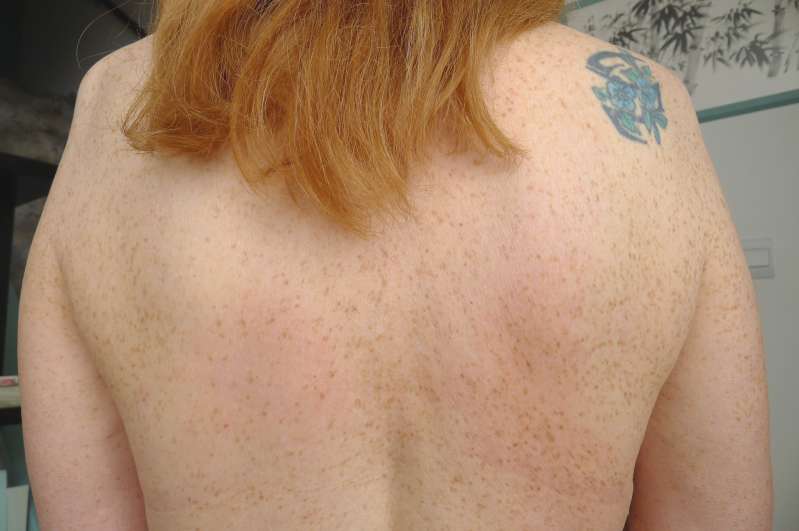
I'm a ginger, so also fair skinned, meaning liable to burn easily. So when the RT Planning session took place and I was warned about the possibility of radiation burns, I took the advice I was given seriously.

I was told to use aqueous cream in place of soap, and as a barrier cream and moisturiser, starting a few days before the treatment and carrying on until a few weeks post treatment. So that's what I did. I hate the stuff, don't feel clean and don't actually think it's a very good moisturiser. Still, at least it doesn't have any nasty chemicals or perfumes which will irritate my skin.

Radiation-induced Eczema: 26/9/2012
Two weeks into treatment and I start to get red, itchy patches on my boobs (where the radiation beams go in) and on my back, diagonally opposite (where the radiation beams come out again). The radiologists think it's probably the first signs of burning. Their advice is, store the aqueous cream in the fridge so it's more cooling, and use it more often. Which I do.

At my next weekly meeting with the oncologists - Dr Carnell herself doesn't come to these, I'm under the TLC of her registrar, Dr Ball (which suits me fine) - I show & tell. The redness has spread to new areas, but not got redder: it's itchy when I use the cream, and it's popped up in one or two places that aren't being irradiated.

The pattern no longer fits in neatly with the radiation beams. Also, the marks aren't getting more intense but instead are spreading out. I think it's eczema. Radiation induced, maybe. Stress related, certainly. I tell Dr Ball what I think.

Dr Ball thinks it's radiation burns. He does however take seriously my comments that the aqueous cream makes my skin itch, and prescribes Diprobase which some patients tolerate better. I try it. It still stings, but less so than the aqueous cream, and still doesn't moisturise very well.

Over the weekend I begin to wonder, why is aqueous cream pushed so strongly when the doctors are clearly aware that some patients can't tolerate it? What is the aqueous cream for, exactly? Would any skin cream do, so long as it's non-irritant? So I start googling.

Many US hospitals do not recommend using aqueous cream during RT, but most UK hospitals seem to think it's good and recommend it for all patients. But however hard I look, I can't find any specific reason to use this particular formulation of skin cream: the criteria seems to be simply about keeping the skin flexible and moist and avoiding irritation.

I'm not a normal patient, I don't have normal skin. 30 years of eczema, and 30 years of all kinds of skin cream, have left me with a sensitive skin. I used aqueous cream briefly and on medical advice back in the 1980's:  it stung then and it stings now.
 
Spreading ??? -induced eczema? : 01/10/2012

More googling, and lo and behold, according to a study by Tsang & Guy published in the British Journal of Dermatology, "the application of Aqueous Cream BP, containing ∼1% SLS, reduced the SC thickness of healthy skin and increased its permeability to water loss. These observations call into question the continued use of this emollient on the already compromised barrier of eczematous skin."
Effect of Aqueous Cream BP on human stratum corneum: abstract

SC, the stratum corneum, is the surface layer of the skin. It consists of dead cells (corneocytes) that lack nuclei and organelles. The purpose of the stratum corneum is to form a barrier to protect underlying tissue from infection, dehydration, chemicals and mechanical stress.

Thinning this layer during RT seems like a seriously bad idea, to me.

Aqueous cream also increases the rate of trans epidural water loss. Not a good idea when one of the criteria for using a moisturiser is to .....the clue is right there in the name.

So now I've stopped using the stuff. I'm putting hydrocortisone cream on the eczema patches and using my normal Dove soap and moisturiser, and the itching has gone away and the redness is starting to recede. As a result I'm more comfortable and relaxed, sleeping better and having fewer nightmares.

When I told the radiography staff I'd stopped the aqueous cream, I got met with concerned frowns. "We recommend that for all our patients" I was told."Yes I know" I replied, "and so do most NHS hospitals. Nevertheless, my skin can't tolerate it, so I'm stopping using it." "You'll have to see the nurse, and show her the cream you're using instead. It's important that it doesn't contain any metals."

So I did, and she was fine about it (although she did suggest going to the Dove Sensitive range rather than the normal stuff). She said, " A lot of our patients can't tolerate the aqueous cream, I don't know why..." I showed her the Tsang and Guy research and she seemed interested. Hopefully, she'll take notice and reconsider the departmental policy to at least tell patients that there are other options.

There's a lovely little research project in there somewhere, for some enterprising nurse or radiographer wanting to make life easier for those of us with sensitive skin.

Postscript: Wednesday 17th October 2012

The skin erythema has largely subsided even though this is at the end of my 5½ weeks of radiotherapy. The skin reaction was not solely down to radiation but due to the effects of the aqueous cream dehydrating and thinning my skin, making it more vulnerable to the radiation.
As soon as I stopped using it, the inflammation started to subside.

17/10/2012: Skin improving after stopping recommended aqueous cream


Friday, 14 September 2012

In Trouble Again

It's Friday. I've calmed down somewhat from the stress of earlier in the week, and I'm getting used to the routine. I turn up, wait in the big waiting room, then the radiographer (who always introduce themselves, first name terms, which is nice: Kathryn or Pira or Claire or Colin or...) take me through to the little waiting area. Then it's through the double doors, round the bendy corridor to the RT machine. Kit off, on couch, some realingment of me on the couch then ZAP!!


But on Friday I went through the bendy corridor to the RT machine and saw two people I'd never met before (a man and a young woman) standing in a corner. She was doing stuff, while he watched. I waited.

After a moment, the radiographer said, "Are you all right Carol?"

I replied, "I'm sorry, I just don't like getting undressed in front of people who haven't introduced themselves."

I got sent to the naughty room.

Of course I didn't. The radiographer introduced them immediately, I got my kit off... all continued as normal.

But it was interesting to note that the 2 newbies were a student radiographer and her male trainer. What? Courtesy and respect weren't part of that module?

Wednesday, 12 September 2012

Trust Me I'm a Doctor: Part 1

I was stressed going in Monday morning, 10th September.  Partly because I was on my way to my first radiotherapy session, again: scary. Also because the appointment time had been changed as “Dr Carnell would like a word first”. No-one likes to hear the phrase “The doctor would like to see you” – it’s inherently scary, too. Still, Godfrey and I reasoned that she probably just wanted to apologise after the balls up last week. Dr Carnell’s Registrar Dr Khan plain forgot to let us know the first treatment  the previous Monday had been cancelled, and so we wasted a fraught trip to London to face the unknowns of radiotherapy for nothing.

An apology? What were we thinking? Dr Carnell explained the reason she wanted to see me was that the proposed treatment had been changed.  The only thing she said, to acknowledge the grief we'd been put through, was “I gather you were messed around last week, but I wasn’t here” Hmmm. I always thought that the buck stopped with the Head of the Clinical Firm, and ultimately the actions of any of the staff in the firm lay with the Consultant in charge regardless of whether they were in the vicinity.

When Godfrey and I first met Dr Carnell, around 6 weeks post-surgery, she  said I needed to have the perimeter of my right lung bathed in radiation using IMRT “which is ideal for this kind of situation”. She described in glowing terms (oh yes, pun definitely intended!) the benefits of IMRT over the conventional, conformal radiation and explained how rogue cancer cells could be lurking anywhere where the tumour had touched my lung or chest wall. That’s a big area: from my collar bone down to the base of my ribs, then sweeping out to the right.

She explained that side effects with IMRT are in general, less severe than for conformal radiation. The radiation is beamed at the target areas from thousands of different directions which means they are able to more effectively avoid healthy tissue and vital organs.  The process was well suited to treating concave surface areas such as the interior of the chest wall, and also where there is constant movement.  When I went in for the planning meeting a week or so later, one of the things they did was study my breathing pattern. It all made sense.


Moving on to Monday, at the quick meeting squeezed in immediately before the first treatment, and Dr Carnell explains the real reason for the delay in starting my treatment. In planning the IMRT the physicists had realised that there was a significant risk of something called ‘radiation pneumonitis’ (RP). This is basically an inflammatory process in the lungs which in the worst cases can lead to scarring and fibrosis in both lungs, with people ending up as a “respiratory cripple”.  So instead, my treatment plan had been revised, meaning the planning had to be re-done using conformal radiation: “back to the old-fashioned way.  Any questions?”

“Errr, what is a respiratory cripple? Sounds like something to be avoided”. “Yes” chipped in the RT department nurse, also in the room and up until then, silent. “I’ve seen it, it’s not something you want to have.”
“Which is why we want to change the plan” explained Dr Carnell, pushing the amended consent form towards me.
 “Do you want me to re-sign that?” I asked
 “Doesn’t really matter, I’m a witness” said the nurse, sitting on the treatment couch, observing.
 I was feeling confused, Godfrey sensed an information vacuum.
“What about the side effects? “  he asked.
”About the same” replied Dr Carnell.
“What about the scarring on the heart?”
“About the same.”
“What about the lungs?”
“About the same.”  

Getting information out of this woman was like getting blood out of a stone.

“What about Carol’s oesophagus?”
 “The side effects on the oesophagus might be a bit worse, you might need to avoid firm food for a while.”

“Will it recover?”
 “Oh yes, after a few weeks.”
The nurse chipped in, “In any case, we can treat that. We can give you things to ease the symptoms”.

Godfrey was still puzzled at the change in the modality. Dr Carnell said they'd tried several times with the IMRT approach, but nothing was safe. Conformal radiation seemed to be the best bet. "The optimal solution?" he asked. "Yes."

So I signed, and we waited for the first treatment. As we waited, we tried to take in the salient points of the lightning quick consultation. Godfrey was saying, there’s something wrong, this doesn’t sit right. He sensed a lot of defensiveness. It wasn’t so much what was being said, as what wasn’t being said.  Afterwards, he began to get more and more concerned. “This doesn't make sense” he was saying “Why did we get all this spiel about how IMRT was so much better, only for Dr Cornell to tell us now, at the last possible moment, that you’re going to have the old fashioned treatment?  How can it be that IMRT’s ideal for treating you one day, and now it could virtually kill you? The medical staff must have known this was the intention when they cancelled last weeks’ appointment, why didn’t they say anything earlier? Why bounce us like that? How come Dr Carnell doesn’t take responsibility for not letting us know about the delay in treatment? So what that she wasn’t here, isn’t she responsible for her staff?”

By the time we got home, Godfrey was bouncing off the ceiling with worry and fury. We looked up RP, and ye gods, it definitely is something to be avoided. In essence, your lungs become leathery and fibrotic and can no longer do the oxygen exchange thing. You can reach a point where you can’t breathe at all, and die. It’s irreversible. A small section of lung can be affected initially, then it can spread through that lung and even into the other side. If you don’t die, you’re on oxygen, gasping for breath, unable to walk more than a few yards.


There are 5 grades of RP:
1) Mild dry cough not requiring treatment
2) Cough requiring narcotic cough medicine or breathing difficulties during activity
3) Severe cough not responsive to narcotics and breathing difficulties when resting, intermittent oxygen or steroids may be required
4) Continuous oxygen or assisted ventilation
5) Fatal

I don't want to be unfair to anyone in this blog, but I do want to be true to my emotional state."State" being the operative word. The more we looked into RP, the worse it got. Some of what follows is, with hindsight, a bit blamey, a but harsh. But that is how I was feeling.

Recent thoracic oncology papers state that 5 - 15% of people treated with RT to the chest area get RP: that’s including lung, breast, oesophageal cancer etc. Not all of them get it severely: sometimes it’s just mild breathlessness or a cough, and sometimes when it’s mild it goes away again. The danger of  getting severe RP (Grade 2 or higher) might be an acceptable risk when you have something terminal. But I don’t. Not at the moment, now the thymoma’s been removed. All I have is a few slow growing cells at the end of a minor blood vessel.

RP is caused by the RT: your chances of getting it vary with the total dose, the volume of lung treated, the fraction size and whether or not you receive chemo at the same time. The critical dosage is 45 Gy: I’m to have 50.4. Over a wide area. And, it’s caused just as much by conformal radiation as IMRT.

We’d been worried about the seemingly extensive nature of the IMRT: I get in principle how it would work for a solid tumour, but couldn’t see how it could be used to treat the ‘rind’ as they call it, where the lungs lie against the chest wall, without doing damage to a load of lung tissue. I’d put my worries down to not understanding fully. Now though, it seems I was right: how come I instinctively knew that, but Dr Carnell, with all her qualifications and experience, didn’t?

We began to play back our previous meeting in our minds, and realised that we didn’t really like what we remembered. When I’d asked questions on our first meeting in the Macmillan Centre on the 6th August, she’d said “it’s all very complicated, you need to have studied oncology for 6 or 7 years to understand this stuff.”  I was somewhat taken aback by her seemingly paternalistic and patronising tone. She also pulled me up when I mispronounced a technical word, like I was some hapless medical student. Today, she’d seemed less than open when answering Godfrey’s questions, and not really explained the reasons behind the change in treatment modality. We couldn't understand how the side effects I was now facing from conformal radiation would be "about the same" as before, since one of  the benefits of IMRT was said to be less severe side effects. Dr Carnell hadn’t felt the need to apologise for the anxiety and stress caused by her staff not telling us of the changed start date. She’d seen us alone the first time, this time she’d organised a witness.


There's a feeling you get sometimes, when someone's giving you unexpected news.It's hard to put your finger on: but there's a sense that words are being used in a very particular way, and meanings are shifting. You run the script back through your mind,and everything seems to be correct, yet the sense is you're in trouble. There was something of that going on in the meeting today, a sense of manipulation; a lack of a true connection.

The only outright euphemism I spotted during the meeting was the nurse saying, "we can treat that", for oesophagitis. Yeah,right. So can a crystal healer, or a reflexologist. The question isn't whether it can be treated, but whether it can be cured. But, as Quentin Crisp said, "Euphemisms are not, as many young people think, useless verbiage for that which can and should be said bluntly; they are like secret agents on a delicate mission, they must airily pass by a stinking mess with barely so much as a nod of the head. Euphemisms are unpleasant truths wearing diplomatic cologne."


The fact that I was looking for euphemisms, for things unsaid, for half truths, for unexplored areas, says it all. I was panicking, and confused, and I had lost faith in my doctor.


STOP! I want to withdraw my consent to RT, altogether. I’ll take the risk of the tumour re-growing, thank you very much.

Trust Me I’m a Doctor: Part 2


By Tuesday morning, after a sleepless night, I’d decided. Unless I got some answers, I was going to pull out of the radiotherapy.

I rang the hospital and asked for an urgent appointment with Dr Carnell, to try and get those answers. She agreed to see me at 1 pm, before my scheduled 2nd treatment at 1.30.

Because of my NHS experience, I’ve met loads of doctors over the years. Most of the doctors I’ve met have been extremely bright and totally committed to doing the best for their patients. Many have been funny, warm, and thoughtful as well. Many are also big-headed: but personally, I accept that as part of the package. You need a certain amount of self-belief if you’re going to cut people open or prescribe poisons for a living.

Being bright, committed and even a bit egotistical doesn’t make them infallible. Every week in the press there’s stories about clinical mistakes. Of course, I do understand that the reason these stories make good copy is that mistakes are relatively rare. I also understand that in RT more than almost anywhere else there’s controls: double checking of plans, calibration of machines, routine monitoring of dosages, regular scans: all possible steps are taken to eliminate error.

I've absolutely no doubt about the skills, knowledge and experience of Dr Carnell. Still though, at heart the decision to treat or not to treat, to handle things this way as opposed to that way, these are all judgements. I want to be included in those judgements. No-one (except Godfrey) has my interests at heart as much as I do. The chances are that I’ll agree with whatever decisions are being made, but I want to be part of the decision up front. I don’t want to wait till afterwards and then complain.

The thing is, I've thought a lot about life, and death, and that grey area in between. I spent a year working as a care assistant for severely physically disabled people. I'm talking about people who, in the main, were fully aware, had normal cognitive ability but no motor control. Think 'locked in syndrome'. Most couldn't speak, couldn't move their arms or legs, and were doubly incontinent. Most couldn't swallow so couldn't eat. Some had degenerative conditions and would die young, some had a normal lifespan. They were there because of MS, or strokes, or an anaesthetic accident, or head injury. I'd rather die than live like that.

So when it comes to clinical outcomes, I'm not interested in pure survival rates. I'm interested in quality of life. I would rather live well for the next 10 years then die prematurely of cancer, than live out a normal lifespan with severely compromised breathing..

I can understand doctor-speak, at least a little. I’m used to being treated by doctors as a colleague, and can’t and won’t accept being treated as a know-nothing patient. Doctors however, are not used to treating patients as colleagues. So Dr Carnell and I might have a communication problem. I’m sure it will be resolved, but there’ll be some difficult moments in the meantime.

I sensed that Dr Carnell and I could be heading for one of those difficult moments.

Godfrey and I had decided that we wanted 4 other options to at least be discussed:
  • Watch and wait. 
  • Treat just the pedicle: the surgical margin - where we know there are cancer cells. 
  • Treat the pedicle and the area immediately adjacent, and maybe the biopsy site. 
  • Seek a second opinion. 
 It all sounds so reasonable, in writing, but on the journey in, I was a mess.

Was I being a fool, everyone else in the world would just shut up and take what was on offer, what did I know, who am I to question a consultant, did I know how lucky I was to even be able to access treatment, supposing I do refuse treatment and it comes back: I’ll kick myself ………………..and

Not inspirational
I’d rather live well and die young than risk being a respiratory cripple, why hadn’t Dr Carnell known at the start what the potential problem was, how come the physicists had to tell her, UCH has a reputation for treating aggressively which is good when you have a carcinoma but maybe doesn’t apply to me, conformal radiation is going to harm me just as much as IMRT maybe more, maybe………… and....


I can’t cope with this, I’m going to make a fool of myself, I haven’t had to strut my managerial stuff in years and don’t know if I can still hack it, I’m panicking, I’m going to cry.


When I got there, Dr Carnell was in a clinic room with another of her registrars, Dr Ball. “Need another witness, do you?” I thought.

I started off by explaining that I knew UCH, and the Oncology department, was on top of its game. That the excellent results they produced were a direct consequence of the aggressive approach they took to cancer, and that it was precisely for that reason I had wanted to be treated there. Then I said “You seem to be treating my tumour as aggressively as if it were lung cancer. If it had been lung cancer, then the risk of side effects such as Radiation Pneumonitis (RP) might be worth it. But it’s not. I had a slow growing, semi-malignant thymoma, which has been excised. Why can’t we just keep an eye on me, and if the tumour comes back, excise it again?”

Dr Carnell explained that it was precisely because the tumour was slow-growing that it needed to be treated so soon, and so aggressively. Where the residual cells are, right up against major blood vessels and my heart, would make future surgery very problematic. The best option is preventative. RT works best on fast growing cells: thymomas do not respond well to RT. Waiting for it to grow and then zapping it would not be straightforward. “The time to treat it is now, when there’s only a few cells involved.”

“But the standard treatment for Thymoma is excision, not excision plus adjuvant RT.”

“Yes, but yours could not be completely excised, there are still cells at the margin. And because you are so young, it will re-grow enough to cause problems later in life.”

I knew about the incomplete excision and regrowth, of course. Hadn’t realised about the complexities of future surgery.  So it looked like ‘watch and wait’ was not as simple as it sounded. But still, the innocently named “side effects” terrified me.

“So, if we need RT, I’m very worried about the potential for severe RP. This hasn’t been mentioned before. I’d rather not be treated and take my chances, than have any risk of that.”

“Yes,” Dr Carnell replied  ”It’s precisely to avoid that that the treatment protocol has changed. The revised approach is to irradiate just the tumour site and a very narrow column of lung immediately in front. There’ll be 3 beams of radiation precisely targeted towards the same area and the rest of your lung will be left clear. YOU WILL NOT GET RADIATION PNEUMONITIS”.

She said, “I don’t know what you’ve been reading, but really, you need to have studied oncology for six or seven years to understand properly what we are proposing to do. You just have to learn to trust me.”

I got cross. I don’t take well to being patronised. I’d heard the ‘years of training’ line before, and I wasn’t impressed. If the CERN Physicist Prof Brian Cox can explain the creation of the solar system with perfect clarity using a pepper pot, a sugar bowl and an ashtray, then I’m sure Dr Carnell could explain my treatment to me. Frankly, it's her job to explain things to non-specialists. That's what all professionals have to learn to do. Also, there's plenty of people like me, who want to understand what's going on and who don't want nursey reassurance. I'm quite capable of reassuring myself, if I have the information.

I said, “I’ve knocked around the NHS system for far too long to take any doctor on trust. Also, as to what I’ve been reading: I’ve not been in the chat rooms, I’ve been reading proper medical journals: the Journal of Thoracic Medicine, Journal of Oncology, BMJ: that sort of stuff. Probably some of the same stuff you’ve been reading.”

“I’m not stupid” I said, “I will understand if you explain”

Then she told me something I didn’t know: that UK treatment protocols were considerably more conservative than international standards. Therefore, a lot of the stuff I’d seen wasn’t comparable. OK, that was news, and reassuring news, to boot.

I asked for a drawing, and Dr Ball said he’d try to pull up the actual planning picture on the computer, if that would help. Very much, yes. In the meantime Dr Carnell drew a sketch, and I began to see what she was talking about. She was proposing to just treat the pedicle and the area immediately adjacent, in a slim column alongside my sternum. That’s OK. That was one of our preferred options. The big sweep across the whole lung had gone. I’m not sure what the plan is for any further microscopic tumour cells elsewhere in the pleural cavity, but I guess if they exist, and re-grow, they will be away from major vessels and will be operable. That’s for another day.

Why couldn’t she have said all this yesterday? The grief, the stress, the time spent reading medical journals, the sleeplessness, the worry, all could have been avoided with a full explanation up front. This extra appointment could have been avoided. Instead, we’ve had to spend half an hour having a meeting which must have been difficult for each of us, and I’m sure we both had better things to do.

Dr Ball couldn’t get the planning pictures up on the system, and suggested taking me to the planning offices to look at my images on their computers. Yes please. I felt the nerd in me rising up, excited. A chance to look at the RT planning process! Yippee!

LINACB Target Definition
Red Line Encircles Target Area: Excision Site, Heart and Anterior Chest Wall.
He showed me the pictures, and they demonstrated clearly the treatment zone and the angled beams. He explained, again, that the risks of RP were very low, “less than 5%”, and that most people who got it, only had a very mild form.

I said, “Yes, but that means for every 1000 people you see with cancers in the chest, 50 of them will get RP. For each of them, they’ll get it 100%.” I know I’m stroppy. That doesn’t mean I’m wrong.

“But nearly all in a mild form, which is treatable. In all my years as a doctor, and all Dr Carnell’s years, neither of us has seen or heard of anyone getting it severely. You don’t need to worry about it.”

“Why’s it on the consent form, then, as a known side effect? Can it be taken off?”

“No, it still needs to be there because it is a risk. But a very small risk.”

OK then. now I understand what's intended and I'm less anxious, I’ll accept a very small risk.

I’m going to remember the words of Dr Carnell :
"YOU WILL NOT GET RADIATION PNEUMONITIS".

We’ll see.

Meantime, I’ll work on my trust issues.

Monday, 10 September 2012

Monday Morning Blues

It's Monday morning again. Radiotherapy (RT) starts today (again). I’m anxious, of course, again.

Actually, it's not so much 'again' as still. I thought that after last weeks' fiasco I'd calm down, have a relaxing week off, enjoy the sunshine, and just chill. It didn't work like that.

Instead I've spent the entire week churning with anxiety. I've felt angry, and stressed, and victimised. I hate feeling victimised.  The trouble is, I'm completely in the hands of the medics. I try and understand what's happening, but I can't really know, not deeply. We're into the realms now of cellular activity, and biochemistry.What do I know about such stuff?  I got biology 'O' level, 40 years ago, but failed chemistry. Twice. I'm not qualified.

I rang UCH on Friday to check that all was well and they were expecting me - I'd had nothing in writing and after last weeks fuck up I wasn't going to trust in a beneficent universe. The chap on reception said yes, all was well, "if there was a problem someone would call you" "They didn't call me last week....."

Then later, we had a call from one of the radiographers asking if we could move Monday's appointment because Dr Carnell, the oncologist, wanted to see me. We weren't expecting to see any oncologists, just RT staff. I got the impression during the phone call that Dr Carnell wanted to explain what happened last week,why the planning was taking so much longer than expected. By Friday evening, my poor old frazzled brain was running out of control, speculating all kinds of nasty stuff. Have they found something new? Looking in detail at the planning CT scan, is there something else wrong? Do they want to do chemo, now, as well? Has the cancer spread?

At the end of the day I have to trust whatever I'm told, But because it wasn't clear at the start what was wrong, over the last 4 or 5 months I've seen many different doctors, and they've all told me different things.Sometimes contradictory things. They all have a different approach, which I do understand, but still. It's just little old me turning up at all these appointments, and whatever is going on inside doesn't change, but the words,and the approach,and the potential impact on my life, does change. It's all very unsettling.

Toppesfield Footpath
We tried to make the most of the good weather this week by going out for a walk in the lovely Essex countryside. Ended up waist deep in nettles. The footpaths where we were clearly hadn't been used in years. We got scratched, and stung, and bitten, and hot and sweaty ; and the lovely village pub with a sign outside saying "Open All Day!" was shut. Bugger.