Showing posts with label Treatment. Show all posts

Wednesday, 24 October 2012

Hats Off to the Radiography Staff

The Radiotherapy has finished now, and although I'm tired, I'm otherwise unscathed. On the outside, at least. My skin has returned to its normal state, thank goodness, and so far there's no sign of radiation pneumonitis, which was a real fear for me a few weeks back.

The way RT works is that I'll carry on cooking on the inside for another 10 days or so, then gradually start to get better. Some of my tiredness it undoubtedly due to the travelling, and that will improve from here on in, but the bit that's due to the cellular damage caused by RT will continue to build. I have some tightness, or soreness,in my lungs and that might get worse, but so far I'm massively better than I thought I would be at this stage.

I wanted to describe what actually happens in an RT session, before I forget, and pay tribute to the staff who make what could be a technical, almost mechanistic process into a relatively pleasant and friendly series of events.

The RT room is laid out a bit like the sanctuary of some weird techno-church, with a wide open space for the radiographers (the Chosen Ones) to do their ritual tasks, an obsidian altar block, and a massive Shiny-White piece of kit which communes with the God of radioactivity. The sacrificial goat (me) lies on the block which floats up and along into the maw of the Shiny-White, just beneath a large horizontal circular disc about two feet in diameter. The disk is Shiny-White on the top but gunmetal inside glass from below. There's a square area in the centre with 2 combs of lead shielding inside, the teeth of which pull back to reveal The Shape.

Varian RapidArc
Shiny White


The Shape is an extraordinary mystical construct created at the most rarefied levels of the Shiny-White priesthood. Aeons ago, High Planners and Planneresses would spend many days crouched over their sacred tomes and esoteric texts before consulting actual goat bones, but today the Planners apply computerised tomography to virtual goats. They have to ensure that the iso-dose curves created by the accumulation of Shapes is high enough to appease the Shiny-White without killing the goat. This takes many years of study.

The Shapes, once divined, are passed to the Chosen Ones. They in turn, ensure the correct Shapes are applied to the correct goat.

The Chosen Ones, in their blue robes, consult The Book (which looks to the goat like a white lever arch file). The Book rests on the goat's legs and contains sacred runes which must be decoded to ensure the goat's alignment will be pleasing to Shiny-White. As they study the sacred text the Chosen Ones begin their strange and haunting chants: "standard AML", "half a centimetre sup", "1.3 ant and inf" "I've got 91.6" whilst moving the goat into the correct position as dictated by Shiny-White. Occasionally a more junior acolyte (in virginal white) is inducted into the Mysteries, under the beneficient guidance of the Chosen Ones.

Once the goat is positioned to the satisfaction of the Chosen Ones, there are still further final ritual adjustments: 3.2 to the left and 11.6 towards Shiny-White.

Then the Chosen Ones retreat to the vestry. The goat is alone in the room. Shiny-White emits a low humming sound as the disc begins to rotate in a vertical plane about the altar. At some pre-determined point, the humming stops to be replaced by a whirr as a Shape is made in the lead shields. Then another noise: something between a buzz and a beep. This can be momentary, or can last several seconds. When it goes above 10 seconds an alarming clicking noise joins in with the buzz-beep sound. Then buzz/beep stops, and with a whirr the Shape is changed: another hum and Shiny-White moves to a new station, and another buzz-beep. For me, there were 4 angel rays (sorry, angled rays) each time.

Grumpy Old Goat
To the goat, nothing seems to have been achieved by all of this. Nevertheless, the Chosen Ones emerge from the vestry seeming delighted. "Well done" they'd say "you're doing really well" and although the goat is a grumpy old goat thinking, "actually, I haven't done anything at all except lie here" still, the goat is pleased. The altar floats back to its original position and the goat is freed.

Despite the ritual being performed correctly, still Shiny-White is not appeased. More goats must be brought forth, and more, and yet more.

Sometimes the ritual is prefaced by the Taking of the Pictures. "We're going to Take the Pictures today" one of the Chosen Ones will announce. This is allegedly a weekly process, but in practice occurs far more frequently, sometimes happening as often as 4 times in one week. Extra fittings emerge from Shiny-White: two small oblong ears and a huge white square, all of which join in a stately circumnavigation of the head of the goat. Usually, that's it. No change to the aural landscape, just the normal hum. No flashes or lights or strobe effects - frankly, it's all a bit dull. But just once in a while the Taking of the Pictures results in rearranging the goat into a position marginally more pleasing to Shiny-White.

The Vestry

The Chosen Ones spend all day, every day, trying to appease Shiny-White by arranging goats on slabs. It's tough work. Shiny-White requires a constant supply of goats, meaning there are no gaps. So any rearranging of goats, or technical problems, delays, administrative foul ups, late goats, or fools asking dumb questions as I was prone to do, results in prolonging the session so that the ritual continues for an hour or more beyond the scheduled running time.

Despite this the radiographers have been a remarkable pleasant and engaging bunch. Always friendly and supportive, never apparently rushed, and seemingly happy to answer my damn fool questions even though these were prolonging the daily grind. They have clearly found their true calling. I take my hat off to them.

Wednesday, 3 October 2012

Half Way There Day

I'm half way there! Oh joy.

This blog is all about my skin care during RT.

I'm a ginger, so also fair skinned, meaning liable to burn easily. So when the RT Planning session took place and I was warned about the possibility of radiation burns, I took the advice I was given seriously.

I was told to use aqueous cream in place of soap, and as a barrier cream and moisturiser, starting a few days before the treatment and carrying on until a few weeks post treatment. So that's what I did. I hate the stuff, don't feel clean and don't actually think it's a very good moisturiser. Still, at least it doesn't have any nasty chemicals or perfumes which will irritate my skin.

Radiation-induced Eczema: 26/9/2012
Two weeks into treatment and I start to get red, itchy patches on my boobs (where the radiation beams go in) and on my back, diagonally opposite (where the radiation beams come out again). The radiologists think it's probably the first signs of burning. Their advice is, store the aqueous cream in the fridge so it's more cooling, and use it more often. Which I do.

At my next weekly meeting with the oncologists - Dr Carnell herself doesn't come to these, I'm under the TLC of her registrar, Dr Ball (which suits me fine) - I show & tell. The redness has spread to new areas, but not got redder: it's itchy when I use the cream, and it's popped up in one or two places that aren't being irradiated.

The pattern no longer fits in neatly with the radiation beams. Also, the marks aren't getting more intense but instead are spreading out. I think it's eczema. Radiation induced, maybe. Stress related, certainly. I tell Dr Ball what I think.

Dr Ball thinks it's radiation burns. He does however take seriously my comments that the aqueous cream makes my skin itch, and prescribes Diprobase which some patients tolerate better. I try it. It still stings, but less so than the aqueous cream, and still doesn't moisturise very well.

Over the weekend I begin to wonder, why is aqueous cream pushed so strongly when the doctors are clearly aware that some patients can't tolerate it? What is the aqueous cream for, exactly? Would any skin cream do, so long as it's non-irritant? So I start googling.

Many US hospitals do not recommend using aqueous cream during RT, but most UK hospitals seem to think it's good and recommend it for all patients. But however hard I look, I can't find any specific reason to use this particular formulation of skin cream: the criteria seems to be simply about keeping the skin flexible and moist and avoiding irritation.

I'm not a normal patient, I don't have normal skin. 30 years of eczema, and 30 years of all kinds of skin cream, have left me with a sensitive skin. I used aqueous cream briefly and on medical advice back in the 1980's:  it stung then and it stings now.
 
Spreading ??? -induced eczema? : 01/10/2012

More googling, and lo and behold, according to a study by Tsang & Guy published in the British Journal of Dermatology, "the application of Aqueous Cream BP, containing ∼1% SLS, reduced the SC thickness of healthy skin and increased its permeability to water loss. These observations call into question the continued use of this emollient on the already compromised barrier of eczematous skin."
Effect of Aqueous Cream BP on human stratum corneum: abstract

SC, the stratum corneum, is the surface layer of the skin. It consists of dead cells (corneocytes) that lack nuclei and organelles. The purpose of the stratum corneum is to form a barrier to protect underlying tissue from infection, dehydration, chemicals and mechanical stress.

Thinning this layer during RT seems like a seriously bad idea, to me.

Aqueous cream also increases the rate of trans epidural water loss. Not a good idea when one of the criteria for using a moisturiser is to .....the clue is right there in the name.

So now I've stopped using the stuff. I'm putting hydrocortisone cream on the eczema patches and using my normal Dove soap and moisturiser, and the itching has gone away and the redness is starting to recede. As a result I'm more comfortable and relaxed, sleeping better and having fewer nightmares.

When I told the radiography staff I'd stopped the aqueous cream, I got met with concerned frowns. "We recommend that for all our patients" I was told."Yes I know" I replied, "and so do most NHS hospitals. Nevertheless, my skin can't tolerate it, so I'm stopping using it." "You'll have to see the nurse, and show her the cream you're using instead. It's important that it doesn't contain any metals."

So I did, and she was fine about it (although she did suggest going to the Dove Sensitive range rather than the normal stuff). She said, " A lot of our patients can't tolerate the aqueous cream, I don't know why..." I showed her the Tsang and Guy research and she seemed interested. Hopefully, she'll take notice and reconsider the departmental policy to at least tell patients that there are other options.

There's a lovely little research project in there somewhere, for some enterprising nurse or radiographer wanting to make life easier for those of us with sensitive skin.

Postscript: Wednesday 17th October 2012

The skin erythema has largely subsided even though this is at the end of my 5½ weeks of radiotherapy. The skin reaction was not solely down to radiation but due to the effects of the aqueous cream dehydrating and thinning my skin, making it more vulnerable to the radiation.
As soon as I stopped using it, the inflammation started to subside.

17/10/2012: Skin improving after stopping recommended aqueous cream


Friday, 31 August 2012

Lung Function Tests

Before the Radiotherapy (RT) starts, I need to have my heart and lungs checked out. This is to put down a benchmark, to see whether and by how much their performance is affected by the treatment. If they are affected (and they probably will be) there's no fixing them, it'll be permanent. So the purpose of the tests isn't so that the medics can some how return my vital organs to their pre-treatment state, because they can't. It's more so that other patients' treatment can be amended, if necessary, in the light of my experience.

I find this all a little bit worrying. I realise that in the modern NHS, improvements in many areas are generated through studying what went wrong in the past. I get that dosages in RT are based on previous experience: in the past some people have probably been given doses that weren't strong enough and so didn't work, and others have been given doses that caused major problems. As a result, today's dosages are reasonably well tolerated by most people. Still, when it's personal, it feels a bit, well clinical. Which of course it is.

Lung Function
There is a narrow, airless corridor in the heart of UCH with chairs all along one side and doors and a small trolley along the other. This is where patients wait for blood tests. The trolley is for a signing in book, so patients can be seen in order. There are usually more patients here than chairs, and the patients aren't routinely told about the signing in book, which makes for confusion. When a patient turns up in a wheelchair, there's not enough room and furniture has to be rearranged. This makes for short term chaos.

At the far end of this corridor, next to the end wall and the water cooler with no cups, is the Lung Function laboratory. My heart goes out to the people who work there.

There's 2 doors: Lung Function and the Sleep Laboratory. A note on the Lung Function door tells you to knock and wait, which I did. A man opened the door and appeared surprised to see me. I explained why I was there, and showed my appointment letter, and he told me to sit down and wait. A few seconds later he came out of the room, squeezed past my legs and disappeared into the Sleep Laboratory. A moment later, he came back the other way. Then another chap came out of the sleep lab, squeezed past again and disappeared into the lung function lab. This was all starting to feel faintly silly.

When I finally got into the surprisingly roomy Lung Function lab, the chaos and confusion disappeared and quiet efficiency reigned. I was to have two different tests, both involving a sequence of breathing in and out and holding my breath. The first measured the expansion of my lungs; the second, the efficiency of my lungs in passing oxygen into and carbon dioxide out of my blood stream.

Lung Function UCLH
Lung Function: Spirometer
The technician seemed a nice chap. His role, apart from the technical aspects of manning the equipment and monitoring the tests, was explain the particular sequence of breathing, then talk me through the tests. He did this by sort of acting out what I was doing.
"Breathe in, in in in in in in....and hold - hold - hold - hold - hold - a bit more, just a bit more......and out, sharply, keep going, keep going, keep going, and.... relax."
All the time breathing in, and holding, himself. I guess his lung function is pretty damn good, after doing that for twenty-odd years.

Spirometry: FVC and FEV ₁ = 107% over predicted
and  a FEV1/FVC  of 85.1%  !!!

I asked about the second test, measuring the efficiency of my lungs. How does that work? Apparently they use proxy gases, at predetermined proportions, and by measuring the mix of gases exhaled that can tell how well the lungs have done their job. The proxy gases are helium for oxygen and carbon monoxide for carbon dioxide.

I couldn't help myself. I tried to fight it, but it just had to be said.
"So you know if my lungs are working really well if my voice goes up two octaves and my lips turn blue?"

"Er, no, that won't happen, we only use a small amount mixed with air..."
Oh dear, I'd thought it was funny, clearly I was on my own. To my shame, it didn't occur to me until the next day that I probably wasn't the first to crack that joke, and after 20 years it had undoubtedly worn a little thin. Oh well.

Echocardiogram

Back to the Heart Hospital for this one. I didn't know what to expect as unusually I hadn't done any research, but it was just an ultrasound. Pretty pictures,though.

 
Echocardiogram of my heart

RT starts on Monday 3rd September. I'm dreading it. Mostly, the drudgery and stress of the commuting: 3 - 4 hours a day, 5 days a week, getting increasingly exhausted from the treatment. But, I'm starting at 2 pm, so should be able to miss both rush hours. Also, I'm not looking forward to feeling rough for several weeks, but I know it's all in a good cause.

Tuesday, 21 August 2012

New Tattoos

So I'm to have radiotherapy.

Dr Carnell has prescribed 50.4 Gy ("Gray") to be given via Intensity Modulated Radiation Therapy (IMRT) in 28 fractions, at 1.8 Gy each time.

First, some definitions.

Gray: according to Wikipedia, one gray is the absorption of one joule of energy, in the form of ionising radiation, per kilogram of matter. The unit is named after the British physicist Louis Harold Gray (1905 - 1965)  whose work in the 1930's, 40's and 50's laid down much of the groundwork underpinning modern radiation therapy. A whole body exposure of 5 Gy generally leads to death within about 14 days: I'm only having a small part of my body treated, and although the local area will be damaged, it will eventually recover. I hope.

 IMRT: this is a kind of high-precision radiation treatment delivered using a linear accelerator (linac). The intensity of the radiation can be changed during the treatment to allow a more intense dosage to the tumour cells whilst sparing adjoining healthy tissue. The targeting of the radiation beams conforms to a precise 3-D image of the tumour cells. Shaped radiation beams are aimed from several angles of exposure to intersect at the tumour. This provides a much larger absorbed dose there than in the surrounding, healthy tissue, allowing higher dosages to be given with fewer side effects.The radiation beams may be moved during treatment, and the intensity changed,  dozens or even hundreds of times.

Fractions: the dose of radiation required is spread out over days or weeks, with the patient receiving a fraction of the total dose on each visit. This allows healthy cells to recover somewhat between sessions, whereas tumour cells are generally less capable of repairing themselves. Despite the high degree of precision allowed by the IMRT machine, it is inevitable that the radiation beams will affect healthy tissue as well as tumour cells. In my case, the beams have to go in through skin, fat, muscle, and bone before they even get to the treatment area. Then out the other side. There will be some damage to healthy cells, but this should repair.

That's the theory.

Now the practice:
Here's a nice little video, courtesy of UCLH, as an introduction to radiotherapy planning and treatment at UCLH.


Radiotherapy at UCLH


For me, the process started on 17th August with treatment planning. There are practical considerations. Delivering the treatment requires repeated visits, with the patient in exactly the same position each time so that the doctor can locate the target for the IMRT, again and again. This requires the correct alignment of the patient in relation to the linac. Even a slight movement of the body relative to the equipment can cause the radiation beams to go off target. Then there are theoretical considerations: the IMRT machine is a hugely flexible tool, but three dimensional planning for this type of conformal radiation is much more complex than for traditional one-slice radiation therapy. Calculating how to do all this takes time and care. There are various techniques to ensure the correct alignment including laser lights, field lights, skin markers and stereotactic modelling, but the first task is to ensure that the patient stays still within the machine, in the same position each time. In my case, this required making a body mould.

A friendly and kind technician called Colin led me into a room containing a couch with a solid surface and notches round the edge, designed to hold a variety of fittings. It was set up for me, with a metal frame at the head end. In front of this was a bright blue bag, which looked like a large, under filled bean bag. Colin explained the treatment process, with particular emphasis on the side effects for my skin. I'm going to get a sunburn-like effect across the right side of my chest. He warned me to avoid perfume or deodorant on the skin until it heals, to stay out of the sun for a year after treatment, and to steer clear of astringent soaps. I need to use aqueous cream to clean and condition my skin for the forseeable: and he gave me a big 100g tube to take home with me.

I lay on the couch with my head on the bean bag and my hands grasping handles behind my head. Colin and his colleague adjusted my position a few times, checked that I was comfortable, then pumped all the air out of the bean bag. This made the whole thing solid, preserving the indentations produced by my head and arms. The bag actually contained polystyrene beads, which lock together when the air is removed so instantly creating a custom made portable, lightweight and rigid piece of apparatus.This will follow me to each of the radiotherapy sessions, ensuring that the alignment of my upper body stays the same.


R/T Mould

The second task was more complex. The target zone of the radiotherapy is inside my lungs which is a) invisible from the outside and b) moving constantly, as I breathe. The radiographers needed to make visible marks on my skin which can be used to align me on each treatment, and to model my breathing so as to fine tune the IMRT as much as possible with my natural movements. So I and the body mould were taken to the radiotherapy planning department.

There were two radiographers, both called Jo, taking me through this stage. I went into a room labelled "CT Simulator" which was confusing as there was a real CT machine in there. Maybe it simulates something else, like radiotherapy. Anyway, the body mould was placed in position at the head of the machine, and I was asked to undress my upper body and get onto the couch. I then lay down with my head and arms held in position by the mould.

I couldn't really see what was going on, but apparently thin green laser beams lined up on my body along the midline and across my chest forming cross hairs. A small oblong white plastic box with black ends was taped to my abdomen aligned to the longitudinal beam, presumably to monitor the rise and fall of my stomach as I breathe. Pen marks were made on either side of my chest, and at the site of the cross hairs. Godfrey and the Jo's left the room and I lay in that position for several minutes while the Jo's monitored my breathing from a side room. Then the machine started up, and I had yet another CT scan.

After the scan, one of the Jo's came out and checked the pen marks she had made. Seeming satisfied, she got some ink, and a needle, and made them permanent. These can now be aligned with laser lights on the linac, ensuring I haven't rolled slightly, or moved down the couch. I and my cancerous cells will be exactly where the accelerator expects them to be, enabling optimum zapping.

3 little scratches, 3 new tattoos. Brings my total to four, so far. The first one's still my favourite!

Tattoos
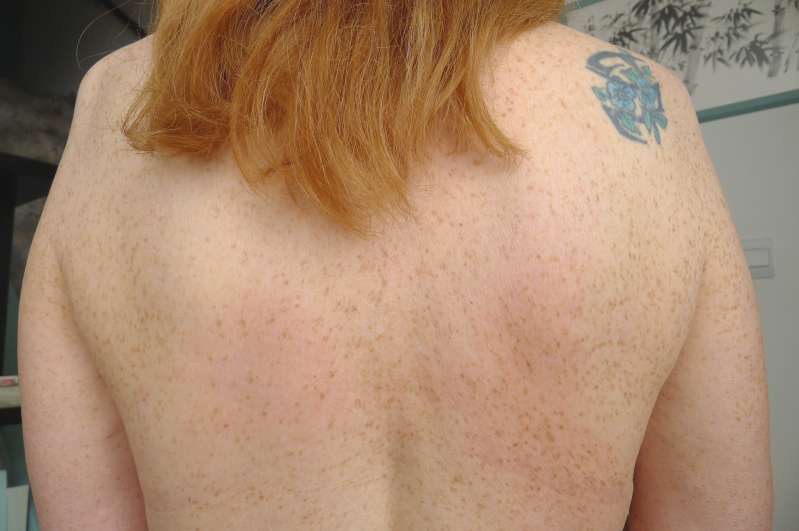
Four Tattoos and some freckles


That was it, I was done. The treatment itself starts on the 3rd September, so I have a few weeks of normal life before then. Although it was overcast, the day was growing warm and so Godfrey and I headed off to the Founder's Arms on the banks of the Thames for well deserved sandwich and a pint. Just as we arrived the sky cleared and we sat there in beautiful sunshine, with a refreshing breeze blowing in off the water. Lovely.

Wednesday, 11 July 2012

Cautious Optimism

After another X-Ray, I saw Mr David Lawrence, the cardiothoracic surgeon, on Monday 9th July 2012 at the Heart Hospital.

Mr David Lawrence BSc(Hons) MBBS FRCS FRCS MS

Broadly speaking, it's good news. The tumour was removed intact (given it measured 7.5 by 5.25 inches at one point, that was no mean feat!) and has since had a through going over by the histopathologists. It seems that it was completely encapsulated, and had not invaded any parts of me. For thymomas, there are several types and stages:  type A is completely benign, and type C is malignant, fast growing and metatasizes. B1, B2 and B3 are in between and have malignant potential. Mine was a B2, on the cusp of malignancy but since it was fully encapsulated, it hadn't invaded any other tissue of organs. What a relief.

Cautious optimism though: there are still causes for concern: little Ridley had a healthy blood supply (which was why he hadn't felt the need to break out of the capsule and feed off me) provided by 2 pedicles. These were snipped and clipped during surgery. There are tumour cells at the incision site on the tumour, therefore probably also on my side. These can re-grow into new tumours. Even with the total resection of a thymoma, which I have just had, there is still a significant chance of recurrence.

There is no agreed clinical protocol on how to manage this situation because thymomas are rare and varied, and cancer management techniques are evolving very quickly so there's no point in looking at statistics from 20 years ago. Mr Lawrence seemed to think that a watch and wait approach was best, rather than subject me to any radio or chemotherapy: that is supported by the most recent research, which suggests that complete resection is the gold standard of treatment for a B2 thymoma, and that adjuvant therapy probably has no impact on the outcome where there is no invasion of neighbouring tissue. [1]

However, that's general guidance.  As a thoracic surgeon, he doesn't think he needs to refer me on to an oncologist, he will discuss the specifics of my case with the UCLH oncolgist Dr Dawn Carnell who has a special interest in thymomas and decide how to proceed after that.

The other cause for concern is that while the medics were working out what was wrong, I had a biopsy. A needle biopsy of a thymoma can "seed" a new tumour in the mediastinum, often near the biopsy site. Still, the biopsy seemed to be the best decision at the time, in order to reach a definitive diagnosis after so many false leads. If I keep having scans, any new tumour will hopefully be picked up nice and early and dealt with promptly.

Heart Hospital


So we're not out of the woods yet, but we can see the open fields: and although the next bit of the path might meander a bit, there's a lot more metaphorical sunlight sparkling in the air now than there was a few weeks ago. Sadly, no actual sunlight, just variations on the drizzle/downpour spectrum, but you can't have everything.

Next step: see what Dr Carnell says about usefulness of adjuvant therapy or otherwise, then probably another CT scan and appointment in 3 months.

1."Which stages of thymoma benefit from adjuvant chemotherapy post-thymectomy?" Attaran S. et al.  http://icvts.oxfordjournals.org/content/early/2012/05/01/icvts.ivs133.full


Friday, 6 July 2012

Slowly Improving

The nature of slow improvement is that it's slow. Although the first few days were actually thrilling: the progress from being able to walk to the corner 50 yards from our front door, to walking half way along the side road, to walking to the next junction was tremendous to achieve, but perhaps less exciting to read about. Since then I have advanced to walking around the block and to the local shops and back. For the first 2 weeks post surgery these minor milestones were a delight to both of us. Equally, for the first fortnight my pain was reducing and my strength increasing, so that I could sleep, and cook (although dishing up was still a problem), and shower, and just do things around the house with ever increasing ease.

I've already been accused by an esteemed member of the legal profession of using this blog just to get my kit off for the internet community,  while pretending that it's in the interests of medical science. I'm not about to name names, but shame on you, Pete. Still, here I go again: my external wounds are healing really well and now look like this:

Operation scar
Healing on the outside


More recently the recovery process has slowed a little, which is to be expected. But it chafes at me. I realise just how competitive I am, how I'm judging myself by my achievements. It's very silly, very childish.

I've been getting more pain in the last few days, too. I'd been given codeine and paracetamol tablets, but had stopped taking the codeine because I can be quite an addictive personality, and I worried about using too many. The paracetamol alone isn't enough though, I haven't been sleeping well. At night, my shoulders, back, and neck ache, and it feels like the bones of my ribs are pressing against each other. I can't find a comfortable position in bed, and moving around without using my arms is hard work. I got on the internet, and it was very hard to find out anything about "normal" pain management post sternotomy, just loads of scary stuff about chronic pain. However I did manage to find some personal accounts by people saying how they were pain free a week or so after surgery, which then made me feel like a malingerer.

Today I saw my GP, who was very kind and supportive. He reminded me that although I was healing on the outside, it's going to take a lot longer for the bones to knit back together. He asked about the various pains I was getting and even supplied me with descriptive words - is it a burning pain, does it feel like the ends of the bones are grating on each other - yes! yes! He's given me a prescription for co-codamol and reassured me about addiction. Apparently what is happening is that my nerves are recovering from the surgery and that is causing more sensation and more pain. I need extra pain management, not less. It's all normal and OK.
Tile House Surgery

Interestingly the GP also implied that people who claim to be pain free a week after thoracic surgery have something wrong with them, psychologically. There seems to be some kind of phenomenon going around whereby people deny the reality of their pain because they are so desperate to recover from things like this: analogous I suppose to women who are frantic to get back into their pre-pregnancy shape within days of giving birth.

It's easy to dismiss this idea as relating to a few oddballs with issues about their own mortality. I wonder though whether it isn't something that goes a bit deeper. There's huge pressure on all of us now to be fitter, younger looking, healthier, slimmer, happier, wealthier, and just generally more Californian than ever before. We're all bombarded with messages about eating our 5 a day, not smoking, taking vitamin pills, drinking just enough alcohol but never ever too much, wearing safety helmets and high-viz jackets on bicycles, taking enough exercise but not over doing it, getting out into the country not for the simple joy of it but for the sake of our mental welfare: the nagging to be healthy never ends. Most of all, we must avoid danger like the plague. And as danger is everywhere, we must also be wary, and fearful, all the time.

As a result of all that scolding, is it any wonder that some of us silently criticise others for failing to achieve health perfection.You've only got yourself to blame, we think about people who fall off motor bikes, or put on weight, or get depressed, or hit the bottle, or get heart disease. If only you weren't so uptight/lazy/greedy/undisciplined/obsessed/fallible. Then it's only a tiny leap to, why should the state pay for him when.....

I wonder whether as a society we're on the cusp of a declaring illness to be a vice.

We are seeing the surgeon on Monday 9th July, hopefully then we will get some information about the tumour, what type it was and what stage, and whether there's a need for further treatment, chemo or radiotherapy.

Wednesday, 27 June 2012

Safety, Kindness, Teamwork & Improving


I’m recovering well from the surgery. That’s the main thing, the most important thing. It would be nice if I was also full of a warm fuzzy glow because of the kindness and care of the staff at the Heart Hospital. Sadly, that’s not the case.

It’s taken me a long time to write this. I’ve been home for 10 days, it’s a fortnight since the operation, and I’m still wondering whether I should say publicly some of the things that happened, or just let it go. The truth is, most people coming out of hospital put the horrible things that have happened behind them and move on, and I understand why they do. But as a result, the situation doesn’t improve. The UCLH values are “safety, kindness, teamwork and improving” and my reflections on my care are germane to each of those values. Also, I shared my side room with 2 other patients, both of whom were brought near to tears with frustration and fury at the way they were treated. Bear in mind this is the Heart Hospital: you would think that raising the blood pressure of patients would be contra-indicated. So I think I will publish, and see what happens.

None of the stuff that went wrong was complicated. It was all really basic nursing and surgical care, and organisational management. There is frankly, no excuse.

Most of the time, there seemed to be a plan of what should happen to me. It’s just that very few took personal responsibility for delivering the plan. Most staff seemed happy to put the burden of doing things onto anonymous colleagues – “someone will be along in a minute to sort that out” was a constant refrain, which I eventually translated as “yes I know it needs to be done, but it’s not my job to do it.” However I never got the impression that the staff actually talked to each other about what was required: there was just an unspoken hope that someone else would pick up the ball they’d dropped. With the result that much of the time, things were left undone until I kicked up. I should just say that the housekeeping/domestic staff were lovely: friendly, thoughtful, kind and willing to help.

I’m not going to bore everyone with all the little niggles of conflicting advice, poor communications, lack of follow through etc. Godfrey’s blog entry on the admissions process: Personal v. Professional, conveys beautifully the chaos at ward level within the hospital. Instead, I’m just going to comment on several processes which could have had a material impact on my recovery. The fact that they didn’t is because I’m young, fit, knew what should happen and was sometimes capable of pushing the system to make sure it did happen.

Other times, though, I wasn’t capable. I’d just had major surgery, was confused, and weak, and vulnerable. My emotions were all over the place, minor things took on major importance and I couldn’t still the voices in my head that made everything feel like life or death decisions. For most of my stay I had chest drains in which caused a lot of discomfort and meant that even small things like getting in and out of bed, or to and from the bathroom, were a major exercise. I really, really wanted other people to look after me. That’s what I thought the nurses were for. Maybe I’m just old fashioned.

I do want to say that I have no complaints at all with one of the nurses, Esther, who was unfailingly friendly, kind and competent.

Apologies for the length of this entry.


Drain Removal
During the surgery I had 3 drains implanted taking fluid from my chest into some plastic bottles. Initially, the fluid was pumped out, later it just drained by gravity. The drains caused some pain and a great deal of discomfort, affected my ability to breathe fully and severely limited my mobility. Clinically, drains should be removed as soon as possible after the fluid has stopped draining, both to improve the patient’s comfort and mobility, and to prevent infection tracking back along the tube into the body cavity.

On Friday 15th June, 2 days post-surgery, the surgical registrar assessed whether the drains were still required. At least, that’s what it seemed like: she didn’t actually tell me anything, but she stood at the foot of the bed and asked me to cough, and then told the junior medics hovering in a nervous pack nearby that what she was seeing was different to what she expected, given my notes. “Cough” she said to me. “See how the tubes are swinging” she said to them. She told the attendant nurse that the mediastinal drain could come out but that an X-ray was required before a decision could be made on the others. Off they went. Later one of the juniors, so shy he could barely make eye contact, came back and told me I’d be taken downstairs for an X-ray later that morning.

An hour or so later Esther explained the procedure for drain removal to me, practised the breathing exercise two or three times and with a colleague, cleanly and efficiently removed the mediastinal drain. “You’ll have an x-ray later” she confirmed “before we can decide on the others, but at least you can move around now.” And I could, I was able to get back and forth to the loo carrying the remaining 2 bottles, and shuffle around the ward corridors.
As for the X-ray, no-one came.  After lunch I asked when the X-ray would take place. “They’ll send someone for you this afternoon” I was told. No-one came.

The next day, there was no medical round, but the shy junior medic appeared and looked vaguely in the general direction of the drains from the foot of my bed. “We’ll get those out today” he said. “Don’t you need an X-ray first?” I asked. “Someone will come for you later this morning” he replied. No-one came.

After lunch, I had a word with Esther. She and I both agreed that as there was no significant fluid draining out any more, the drains could probably go. I said that I thought not getting the X-ray was delaying their removal. About half an hour later, a porter arrived to take me to X-ray, and the drains were removed at about 4.30 Saturday afternoon, 72 hours after surgery. Having a chest drain removed is the weirdest sensation I have ever experienced, but immediately I felt so much better. I could breathe fully, the pain and discomfort had gone and my energy levels picked up instantly. I rang Godfrey who had gone home after visiting, and he could hear in my voice how much better I was. But the most significant thing was, I could get about more freely. Mobilisation is really important after chest surgery, and now at last I was able to mobilise.

I was only in hospital for 4 days, one in ITU and 3 on the ward. The time on the ward was all about wound healing and mobilisation. In that context, the fact that it took from Friday morning to Saturday afternoon to get the X-ray which was a precursor to removing the drains, seems pretty inefficient. As a result, the stab wounds for the drains had less than 24 hours to heal before I was discharged. It seems pretty basic to me, that where there’s a clinical and operational need to get the patient mobile, the requisite investigations should take place promptly.

Nebuliser
Early on the Friday morning, my first morning on the ward, a nurse fitted a nebuliser at the side of my bed, behind my line of vision. “Someone will come along later and show you how to use this” she told me. On Friday, I was not a well person. I was still confused, dozy, unable to concentrate and vast tracts of time would just disappear as I drifted in and out of consciousness. I completely forgot about the nebuliser.

On the Saturday I saw it out of the corner of my eye, and remembered the nurse fitting it. I assumed it wasn’t important, otherwise someone surely would have come back and explained it to me. Because I’m registered asthmatic although I haven’t used an inhaler for maybe 20 years, I thought an over-conscientious nurse had probably provided one for me.
At about 10 pm Saturday, the nurse doing the evening drugs round asked if I’d like to use the nebuliser. “I’m not sure I need it: my ‘asthma’ is asymptomatic” I replied. She explained that it had nothing to do with asthma, and instead was an essential aid to recovery. Blood clots can form in your lungs and the nebuliser helps you cough up bloody phlegm, reducing the chances of post-surgery infection. Oh. I wish I’d known. Now I was scared that I’d created a post-surgical mega-problem. However, coughing post sternotomy is extremely painful and in any case I needed to sleep, so we agreed I’d use the nebuliser in the morning.

At 7 a.m., the same nurse returned, fitted it and told me what to do. “Keep going for 10 – 15 minutes” she said “and I’ll come back and see how you’re doing.” I never saw her again. After about half an hour I took it off myself. I didn’t cough during or after using it, and no-one ever mentioned it again.

I don’t know whether a nebuliser is essential post-operatively, or not. If it is, it should have been explained to me and I should have been enabled to use it. Otherwise, it should have been discussed as a treatment option. Instead, what I got was a physical piece of kit that I couldn’t use (because I didn’t know how to, and in any case couldn’t physically get to it for the first day and a half until the drains were removed) and a shed-load of fear that I was going to die because I hadn’t used it.

Dressings
Sunday morning: the drains came out the previous afternoon and this was my first chance to have a shower. Exciting! I still had gauze dressings on the upper part of my sternum, and over the drain site. I asked a nurse what to do, and she said to shower first and she’d come back in 10 minutes or so to change the dressings. Off I went to the shower, enjoying my drain-free movements. Still, though, showering is hard work. Everything aches. Bending down is a slow, carefully executed process. Putting on pyjamas takes thought. With a genuine sense of pride, I managed a successful shower and returned to my chair, complete with wet wound dressings.

20 minutes later, the nurse hasn’t returned so I decided to take the initiative and call someone to change the dressings. I could have pressed the buzzer, but I was supposed to be mobilising, so I decided to walk round to the nurses’ station. There were 3 or 4 nurses there doing nothing so far as I can see, but that’s OK, they’ve got to be somewhere between finishing one thing and starting the next. So I explained I’d just showered, and asked whether someone could come and sort out my dressings. “Go back to your room, someone will be there in a minute.” 25 minutes later, no-one had come. Worryingly, the drain wounds had begun to itch.

I think about at least removing the old dressings myself. But then I think, what if something goes wrong? The drains only came out yesterday afternoon, what if removing the dressing means the wounds start to bleed? What if blood clots from deep in the wound are adhering to the dressing and I pull them out as I remove it? What if there are signs of infection? You do hear these scare stories. To be honest, I also think, I’m the patient here. I’m getting better, so I’m getting angry.

I went back to the nurses’ station. Different people there now, but still about 3 or 4 of them, still apparently doing nothing. “Could someone please come and change my dressings?” I asked “I had a shower about 45 minutes ago, the dressings are wet and the wounds are starting to itch.” One of them glanced at my sternal dressing. “You can remove that one yourself” she said, with what felt like contempt. “And the dressing on the drain wounds?” I asked “The drains only came out yesterday, I thought you might at least want to see how they are healing...” “Go back to your room, someone will be there in a minute.”

This time, someone did come, and the dressings were changed, and all was well. But it might not have been. Dry dressings which have got wet with unsterile shower water are a breeding ground for bacteria, and when the wound goes right through into the chest cavity, the complications can be serious. The nurses didn’t know what was under the drain dressing, whether the wound was healing or not, whether there were signs of infection or otherwise. And what is worse, they didn’t seem to care.

Wearing a Bra
When you are a middle-aged top-heavy woman, your boobs naturally fall downwards and outwards, pulling away from the midline. It’s neither comfortable nor dignified, so I wear a bra.

When you have a sternotomy, your breastbone is cut in two along its length. Closure is performed by wiring the two halves together, and the skin is then glued back together again.  You really don’t want unfettered boobs in these circumstances.

In fact, the guidance leaflet from UCH "Information for patients following a Sternotomy” says:
For women, do ensure that you wear a well supportive and comfortable bra (i.e. a sports bra). This will prevent your breasts pulling at your sternal wound. You will need to wear this from the day after surgery.

I didn’t get this leaflet until the Friday afternoon, 2 days after surgery, but luckily before I went into hospital I had researched my likely condition post-surgery and ensured I had a range of cotton, front fastening bras with me so that I could be comfortable afterwards.

So I asked in ITU whether I could put my bra on, and they said yes, fine, was it in my washbag? No, it was in my overnight bag, which was in storage and wouldn’t be brought to me until I got onto a proper ward. Shame no-one had pointed this out to me in Admissions, but hey. Never mind.

A Pillow for Support

When I got onto the ward I couldn’t get out of bed: the chest drains were attached to the suction tubes. Never mind, the attentive admitting nurse was very helpful. I asked whether I could put a bra on, and he said “No. I don’t see how you can wear a bra with those drains in.” I only had the vaguest idea where the drains were, I was confused and exhausted and accepted his word. So I spent all that night and the next morning bra-less, trying to support myself with a pillow.

On the Friday, when the suction was stopped and one of the drains removed, I was finally able to get out of bed, find my overnight bag and put on a bra. The drains weren’t in the way, not even close to the bra line. Instantly, propriety and comfort were restored.

The point about the bra, though, isn't just my comfort. It's that heavy breasts pulling against a new wound could conceivably tear that wound open. Hence the guidance says, not that you might want to wear one, but that you will need to wear one from the day after surgery. How come the ward nurse doesn't know this? After all, I was in the Heart Hospital. You’d think the staff would be used to managing women post-sternotomy.

Discharge Process
Late morning on Sunday, a junior medic I’d never seen before came in to the room, looked at my notes, and without examining me, said I could go home. I waited for him to say tomorrow, or in the next day or so, but he meant now. He was being premature actually, as the established protocol after drain-removal includes a radiograph to detect any new fluid or air collection. This hadn't been done.

This was the first time anyone had mentioned discharge.  I was stunned. I had been told the stay would be 5-7 days and it had barely been 4 days; the poxy drains had been out for less than 24 hours and so far, I hadn’t even ventured off the ward to see how far I could walk. I didn’t know if I could make it to the hospital shop, let alone get myself across the concourse of Liverpool St Station, through all the crowds. I was handed a piece of paper and told to get myself to X-ray for the final scan.

Instantly the doctor mentioned discharge, the atmosphere in the ward changed. The nurses, not exactly friendly in the first place, became downright cold. It was made clear that from now on I was in the way, I had shifted from patient to bed-blocker.

I rang Godfrey, who was still at home, planning to come and visit that afternoon, and told him I was coming home. He was stunned. “You’re not ready” he said, and I agreed. Still, we all know about pressure on beds, so we accepted the inevitable. I went downstairs and had the X-ray done, and came back.

It was lunchtime, so I ate and was resting in the chair after eating, then a nurse came in, sat on my bed and said, “Are you ready to go?” “I can’t go yet” I said, “I’m waiting for the results of the final X-ray”. “Only we need the bed, we’ve got someone else coming in” she said. And went. So, I packed up my stuff, called Godfrey again, and waited.

About an hour later, my bedside phone rang. It was one of the nurses saying the X-ray showed no effusion, so I could go now. I can’t leave just yet, I said, I can’t carry my own bags and my partner’s not here yet. “Where is he?” “On the tube, on his way” “When will he be here?” “I don’t know, I can’t contact him, he’s probably in a tunnel.” It’s a Sunday service on the trains: it takes as long as it takes. “Only we need the bed” she said.

OK, I said, could someone give me a hand with my bags? “Someone will come soon”, she said. I waited. After about half an hour, no-one had come. I walked round to the nurses’ station, the usual gaggle of 4 or 5 nurses there doing nothing, and I asked,  “Could someone please come and help with my bags?” “Someone will be there soon” one of the nurses said without looking at me. I went back to my room.


About half an hour later, no Godfrey, no porter, no nurse, no contact from anyone. I was unhappy, and stressed, and not thinking clearly. Suddenly, I couldn’t stand it anymore. I’d had one too many “someone will be there soon”s. I needed to vacate the room, but couldn’t lift my own overnight bag, I’d just had a sternotomy and wasn’t allowed to carry anything heavier than 6lb. In desperation, I picked up my light hand luggage and began to kick my overnight bag along the corridor towards to the lifts, just in front of the nurses’ station. 

When I got to the nurses’ station, one of the 4 or 5 people loitering there turned and looked at me with horror of her face. “You can’t kick your bag down the corridor like that!” she shouted, and grabbed it up off the floor and put it down on the dressing trolley. I saw red. “Don’t put my dirty bag on your clean dressing trolley!” I shouted – I’m not even a qualified nurse, and I know you just don’t contaminate them like that. “It’s all right, we clean it all the time” she replied defensively referring to the trolley. Then the lift came, and she snatched my bag off the trolley and put it in the lift. “There you go” she said. She turned her back, and left me to get into the lift alone. The other nurses all ignored me.  At the ground floor, I had no choice but to kick my bag out of the lift and along the corridor to a waiting area.

By the time Godfrey arrived, I was in tears.

It should have been possible to a) prepare me for discharge by mentioning beforehand that as I was healing well I might go home early, b) to allow me to wait until Godfrey came – he was on his way after all, c) to tell me a porter had been requested (if one had) to help me and give an estimate of how long I’d wait, or d) for one of the nurses to say, hang on I’ll give you a hand with that bag.  But none of that happened. It was cruel.


Final Thoughts
I’ve gone on for long enough. I haven’t mentioned my difficulties with anti-emetic drugs, or the lack of any post-surgery clinical feedback, or the mysterious physio process whereby you learn breathing exercises by telepathy, or any of the other minor annoyances, because it’s too boring and didn’t affect my condition.

All the things I have mentioned were OK in the end, but might not have ended well. All of them could have been avoided with only the tiniest bit of care or concern. Nothing that went wrong was to do with inadequate training, or lack of equipment, or poor staffing levels, or any of the other excuses you always hear bleated out when there’s a court case. All were about a lack of empathy and understanding of what it is like to be a patient.

I’m still wondering whether to raise these matters formally with the Trust, or whether I’d be happier if I just got on with my life. Maybe I should attend more to the sacred words of Eric Idle…………….
“Some things in life are bad
They can really make you mad
Other things just make you swear and curse.
When you're chewing on life's gristle
Don't grumble, give a whistle
And this'll help things turn out for the best..
And...
Always look on the bright side of life...
Always look on the light side of life...”

Sunday, 24 June 2012

Recovering

I've been back home for a week now, and am slowly recovering.

I think I was probably discharged too early. I've been in a bit of a daze since I got back, prone to bursting into tears at nothing at all and feeling not at all sure what was going on. I've been completely obsessing about the care I had in hospital one minute (of which more on another occasion) and then the next, just unable to think about it at all.

The King's Head, Westmoreland Street, opp. Heart Hospital
The King's Head
A fortnight before the operation, we met a man outside the pub opposite The Heart Hospital who'd had open heart surgery there. He was saying that he felt really odd after the surgery - his heart had actually, physically been touched by a stranger, and not in a good way, and it felt so wrong. He had been saved by the surgery, but also violated by it. I don't feel that way, but I do feel  that the experience was extraordinary and should change me forever. The fact that such an event can happen - on the physical plane, that my chest can be opened so wide that the muscles along my spine ache, and then closed again and I will probably be fine afterwards; and on the meta-physical, that my apparent healthy active life was actually a lie because  all the time I was harbouring a silent killer - these are big things to deal with.

My reactions so far are puny. I don't think I've really taken in the reality of the situation. I've been getting tearful for no reason, feeling an existential sense of loss, but haven't yet taken in the fragility of life and the importance of being true to my core self and the people I care about. I'm still focused on trivial, practical things.

I'm doing breathing exercises, to get back the full use of that pesky right lung which has been squashed for so long and we are trying to get me moving, to build up my stamina. The first time we went for a walk, I got about 70 yards before I had to turn back. Yesterday, we went over 500 yards and although I was breathless when we got back, I recovered quite quickly. So that's good.

We were worried for a couple of  days about the incision scar, it seemed unusually hot, red, itchy and raised, but didn't seem to get any worse and I didn't have a temperature, and now that's getting better too. The scar goes the whole length of my sternum, and there are 3 new belly button holes beneath my rib cage, where the drains came out. Look away now if you're of a nervous disposition:
5 days post surgery


On a practical level, it's very odd, what I can do and can't. (I wish I'd paid more attention to anatomy lessons at AT school, but I used to doze off all the time. More than once, I was still asleep in the corner when everyone else started going home.) Anyway, anything using my chest muscles is, of course, compromised. I can push, but I can't pull. Carrying mugs is easier than carrying plates. Simple things like washing my hands or opening a jar or getting off the sofa hurts just a bit.

On the other hand, I really thought a week after discharge I'd still be lying on the chaise longue with Godfrey feeding me peeled grapes. Instead, I'm pottering around the house and garden, and so long as I'm careful, I'm doing OK.

Monday, 18 June 2012

Back Home!

Welcome Home

I'm home! Back in sunny Brentwood!

The operation has been done and the thymoma extracted, and after 24 hours in ITU and 3 days on the ward I was discharged back into Godfrey's care yesterday (Sunday). It was a bit of a surprise all around, quite honestly, but I'd far rather be here than there, and I seem to be OK.

We think the operation was successful, and although there's things to say about the hospital stay, I'll save that for another day.

Many thanks to all for kind and thoughtful e-mails, cards, letters and comments.

Wednesday, 30 May 2012

At Last - Some News


The Heart Hospital, London W1G 8PH

I saw Mr Lawrence, the Cardiothoracic Surgeon, yesterday.

We finally know what sort of cancer it is: it's a thymoma, a tumour of the thymus. It's a particularly big one. It starts at the thymus below my breastbone and has grown down inside my chest to the base of the ribcage and then across so that it is pressing against my ribs on the right hand side. As a result, my right lung is crushed into a squelchy pocket about half its normal size, and my diaphragm on the right side is probably not working at all because of the weight of the thymoma pressing down on it. That partially explains my exhaustion, also I have quite a bit of pleural effusion - fluid produced by the lung to stop the thymoma rubbing up against and abrading other tissues - and that make you tired, too.

There are 3 types of thymoma: A, B, C: A being non-malignant and C aggressively malignant. Mine's a B, somewhere in the middle. Thymomas which are benign can and often do become malignant, and sometimes the malignancy shows up microscopically, i.e. you can't see the difference by looking at the scans. Therefore the plan is, to try and take the whole thing out and send it off to the lab for a thorough check out before deciding on further adjuvant treatment such as chemo/radiotherapy.

Mr Lawrence says it appears to be encapsulated which is a good thing. He hopes to take it out in one lump, but because it's so big - it's the biggest he's ever seen - he may have to cut it into two pieces. If he does that, then of course he'll break the capsule and there's a risk of releasing bits and pieces back into the chest cavity. But getting it out in one lump might mean he has to move other organs out of the way - stop my heart and move it over to one side for example. Hopefully if that happens he'll remember to start it up again afterwards.

Next: there are 4 stages of Thymoma, stage 1 being a small local lesion on the thymus which is benign, and stage 4 being an aggressive and invasive cancer, invading other organs/vessels in the vicinity. Stage 2 and 3 are in between, and defined by the degree of invasiveness. Mine is probably stage 2 or 3. Although mine looks encapsulated, the surgeon won't know if the encapsulation is complete until he tries to get it out. It's not until then that we will know what stage it's at.

He's concerned about whether the pulmonary blood vessels are affected. These are the blood vessels which take oxygenated blood from the lungs to the heart to be pumped round my body, and then take the de-oxygenated blood back the other way. They're kind of important.

So, what was he like? He was a very nice chap, with a proper public school accent like wot I don't have. He talked to us for about half an hour and answered all the questions, but what was great was that although he was fine talking to us, what really rocked his boat was the prospect of doing some difficult and challenging surgery. His face lit up when he looked at the scans, you could see him holding an imaginary scalpel, thinking through how he was going to make the surgery work. That's what I want from a surgeon! He's going to take it slowly, because getting the tumour out through the hole will be problematic, particularly if there's some adhesions and/or invasions around anything crucial, and so he has set aside the whole morning for little old me, and asked his secretary to ensure he has a fairly easy afternoon afterwards. He'll need some time to recover, and so will I.

The operation is scheduled for 13th June, in the Heart Hospital in Marylebone.

David Lawrence Consultant Cardiothoracic Surgeon


Tuesday, 22 May 2012

Cumulus Tumour?

I don't know where to begin with this post. I feel as though Godfrey and I have been living under a cancer cloud for so long, and yet it's only been about a month. Every time we see a professional, we seem to get a different story. Then it's back home and some intensive hours googling, trying to get answers to all the questions we didn't even know we should have asked, only for the next doctor to send us off in a completely different direction. It's exhausting.

Yes, I know we are making it worse for ourselves with all the googling, but it's not in either of us to just go along passively with the experts. Not in a situation like this.

The Oncologist Judy King said that the MDT had decided that the tumour was operable. Which is brilliant. A median sternotomy is the preferred procedure - it's going to mean cutting the sternum vertically in half and prizing my ribs apart, and having a good old rummage around inside my chest cavity to see how much of the tumour can be removed. There are delicate bits of anatomy in there which need to be left intact, like the phrenic nerve and superior vena cava. Followed by radiotherapy. I'm going to feel smashed around, for a long time. Bring it on.


Sadly we couldn't get to see the surgeon, Mr David Lawrence, to ask any questions. Apparently he'll contact us over the next few days with a view to seeing us next week, probably. We don't know whether all the cancer can be removed or whether some of it has invaded the tissue of other organs besides the lung in the mediastinal compartment- they can't see that much detail on the scans, so Mr Lawrence won't know until I'm under the knife.

I'm ready for the surgery, up for it. It's the waiting that's so draining.


Thursday, 17 May 2012

PET Scan

I had a PET scan yesterday.

PET Scanner
UCH PET Scanner

Is it trivial to comment on how uninspiring the experience was? After all, it's a hospital procedure, not Alton Towers, I've got cancer, I'm not on holiday. Nevertheless, the FDG PET/CT scan was by far the most tedious cancer-related experience so far. We went into a dreary featureless room with lead-lined bays and I was given a dose of Fluorine-18 and then lay still for about an hour. We chatted, then I dozed for a bit. Then off to the scanner where I lay down and was whizzed in and out for another 40 minutes or so. It was cold, but mostly just soporific.

I don't mind it being dull, the point was to get good images, so that the team can make some decisions next Monday. But I'm trying to be honest, and it was, well, boring.

I'd expected more sensation from the scanner, maybe something like the fillings in my teeth being tugged, as you get under pylons, or a noise like a tube train like I heard in the CT scanner. Or maybe the occasional disembodied human voice "Breath in Carol, now breathe out". Or some beeps.

We were tired, after another early start, and I was hungry because I needed to fast before the procedure so that the isotope was rapidly taken up by the cancer. Maybe that influenced my mood.


We quite liked the PET chairs, though.

Tuesday, 15 May 2012

Discharged from Sarcoma Service

We went up to UCH yesterday and saw the wonderful Dr Shui from the Sarcoma team, and I was formally discharged from his care.

University College London Hospital

Following the biopsy last Wednesday, Dr Shui had called us on Friday evening to let us know that histology showed the tumour was not a sarcoma, and therefore he was not the appropriate doctor for me. He could have just discharged me back to Basildon, or to the GP, but he went out of his way to refer me internally to the lung cancer team at UCH, making sure he'd spoken to one of their team about me, and ensuring they had my notes for their MDT meeting on Monday lunchtime. He even managed to set up a preliminary appointment with one of the registrars on Monday afternoon. I will always be grateful to him for giving a level of service and care that I just didn't expect from the NHS.

One of many jobs I held in NHS management was as the Head of the commissioning team for Acute Services, for the residents of Barking and Havering. I learned a lot about hospital services all across Essex as part of that role. As a result, I have a mental list of hospitals I will NEVER willingly be treated in. This list includes Southend Hospital, but not Basildon.

However, it turns out that the Lung Cancer service in Basildon is not a full service. It seems to be limited to diagnosis and out patient appointments. All chemotherapy and radiotherapy is done at Southend. Southend is the kind of place beset by low morale which causes multiple minor frustrations and annoyances. As well, the parking is difficult at best and the public transport links appalling. Although I've no evidence that, in general, the clinical care is any worse than anywhere else, still I wouldn't want to place my life in their hands.


Lung Cancer Treatment: Basildon and UCH Compared
There are 2 main categories of Lung Cancer: small cell and non-small-cell lung cancer (NSCLC). For NSCLC, there a 4 stages of cancer, stage 1 being early in the disease when the cancer is small and localised, and stage 4 being later, after the cancer has metastasized and spread. Both categories should be treated as aggressively as possible, given the general health of the patient.

The following is extracted fom the National Lung Cancer Audit Report 2011


Average* Basildon     UCH
% of NSCLC having surgery  13.7 10.8 19.6
% of PSO-1 Stage 3B or 4 NSCLC having chemo 52.8 51.1 64.4
% small cell receiving chemo 65.1 44.4 94.7
% of NSCLC Stage 1 & 2 having surgery 48.8 53.6 72.2
% histologically confirmed NSCLC having surgery 18.3 13.8 21.6
         [Link to PDF]                                         * England & Wales n=32,347 cases first seen 2010 

Clearly, I'd be much better off at UCH and thanks to Dr Shui, UCH will continue to treat me. Before discharging me, Dr Shui explained the results of the tests he had had back: I don't have sarcomatoid cancer, nor do I have a germ cell tumour. There's no indication of, for example, bowel cells in the lung tumour which would indicate it was a secondary cancer. It is a cancer though, and a big one. He showed us the chest X-ray and the CT scans, and the mass seems to fill about a third to a half of my right lung. He said the interesting thing was that I was so well, given that I have such a large mass inside me.

The same afternoon I saw Dr Judy King, Darzi Fellow Medical Oncologist. She was  very approachable and helpful and explained the next stages. At the end of the consultation, we met the head of the Oncology Department, Professor Lee who was a very nice man and clearly one of the leading clinicians in the country in this field. He said he wanted "light the tumour up in a PET scan". So that's now scheduled for Wednesday at 9.00am.
With the PET scan results, and final histology reports, I'm hoping for a diagnosis at the next outpatient appointment on the 21st May, when we'll get an opinion as to whether surgery is an option.

Wednesday, 9 May 2012

Biopsy

Each time I sit down to write a blog entry, I immediately get caught up in displacement activities. Check out South Georgia  - it's stopped snowing and the sun is rising and the snow covered peaks are turning a beautiful warm pinky colour. Read the papers. Play patience. Look out of the window, make yet more tea, comb a cat or two - anything rather than sit down and write something about me, and what I've been up to. Of course, it's true: I don't really want to be blogging at all, I don't think people are that interested in what I have to say. And I certainly don't want to be blogging about health problems, they are something that happen to other people, not me. My health has been so good for so long that I take it for granted, and get mildly affronted when I come down with a cold or something.

Which isn't even true, actually. I've had severe eczema for much of my adult life - the sort of thing where my dry skin cracks and bleeds and I can't wear pale colours in case it shows, or where you can always see where I been sitting because of the tell tale dusting of dandruff-like skin fragments around my chair. That went away, then a few years later I had some mental health problems. Then later, I had recurrent skin infections, then alopecia: when you stop and think about it, I'm a wreck.

But none of those things stopped me doing stuff, getting on with life. This, this tumour thing, is stopping me. I find I get really tired doing the least little thing, like making breakfast, or having a shower. I don't want to live in a world where emptying the dishwasher is something I have to recover from - Phew! I've just put away 8 mugs, 2 saucepans, and a selection of cutlery, now it's time for a break! I'm not even on chemo yet and I'm going on like this. I'm mystified as to why, and why so suddenly. I beat myself up that it's all psychosomatic, and actually I'm fine but taking the opportunity to be lazy - who can say?
Carol, UCH Canteen
Me in the UCH Cafe

Anyway, the biopsy.

We set the alarm for 5.30. I was awake at 4 and although I tried to sleep some more, it didn't take. So I got up at half past 4. Light breakfast and a shower, some recovery time, and we got a cab just before 7. Train and tube into UCH: we got there about 8.15 in time to have a cup of tea in "The Cafe" - my, how things have changed. I remember working at Barts in the 1980's when the only facility for patients and visitors was the grubby WRVS canteen in the bowels of the hospital round the back somewhere. It had a giant institutional tea pot full of not quite hot enough tea which was strong enough for depilation should you wish, and a choice of rolls in ham or cheese. An unchanging coffee cake under a plastic lid by the tills, made during rationing and last tasted in 1964. Opening hours: 11 - 11.30 and 2 - 2.15: plastic chairs and wobbly tables and a single lightbulb hanging over the till. By contrast, "The Cafe" at UCH was bright, spacious, and welcoming. It had a huge choice of things to eat and drink and you could watch the world go by while girding your loins for things to come. Well done UCH.

We got up to Imaging just after 9, and were led off to a treatment bay where I was asked the standard questions & got changed into the hospital gown. Then we were whisked down the corridor by a reassuringly breezy radiotherapist to the scanner room. The clinician who was to perform the procedure was Dr Taylor, a very pleasant lady who had a reassuring air of quiet competence. She gave us an absolutely clear and precise account what was to happen and possible side effects, then Godfrey went back to the waiting area and I got scanned. Except I didn't: first the machine broke down, and once they'd tried turning it off and turning it on again, they had to send me away and wait for a man with a hammer to come and fix it. 40 minutes later, we were ready to go.
CT Scanner
Siemens Somatom Sensation 64 !

Just before the scanning started, Dr Taylor suddenly realised that poor Godfrey was unaware that there'd been a delay, and sent someone to tell him, so that he wasn't alarmed by my long absence. I was impressed, I was expecting more of an "it takes as long as it takes and you'll just have to wait" philosophy. Thumbs up to UCH, again.

Then all the lying down, sliding in an out of a giant polo mint. Repeated scanning. They scanned me first, to see the tumour and decide how to proceed. Then a guide tube was inserted under local anaesthetic, which was quite uncomfortable at times although not exactly painful. At each stage of the tube insertion, I was slid back into the scanner to check the placement. Then a clipping tool was put down the guide tube and pieces of the tumour were snipped off with a loud "Clip" noise.

Then it's all over, and off to the endoscopy recovery unit to recover. After a lung biopsy, there is a danger of creating a pneumothorax. So they do an X-ray after one hour, and then another 4 hours after the procedure. Then we were good to go. We left the hospital at about 4, and were home by just after 5.

I saw the CT image of the tumour, and Dr Taylor has kindly promised to send me a copy to put on here. But in advance of that, if you imagine your chest cavity as a kind of open figure 8, the tumour appeared to take up about half the space on one side. She said it was well defined, and pushing other vital organs aside rather than engulfing and absorbing them, which is good. The image I saw was only a slice, at one particular horizontal level in my chest. It could be bigger or smaller at another level. But I'm puzzled, because I glimpsed one of the X-rays as well, where it seemed to fill the lower portion of my right lung. In my head I can't square the two. All will be revealed on Monday when we're going back to OP and will, we hope, get a diagnosis.

CT Scan Biopsy
CT Scan: The clipper is about 2cm beneath the guide tube you can see, and the void below is where the material was clipped from. This view is looking up from my feet: the tumour is in the right lung

We were both shattered when we got back, and I went to bed at about 9 and slept for 11 hours. But I'm still tired now. I'm starting to realise that this time, I have an illness which won't let me carry on as normal, which will force me to confront how much of my own self worth is defined by what I do rather than by who I am. Uncomfortable times ahead, I think.