It's the middle of March and time for a post treatment clinical assessment. This will revolve around my signs and symptoms and a review of the post-treatment CT scan. Hopefully it will go along the lines of, "Everything looks OK, see you again in 6 months". The scan isn't expected to reveal anything - my thymoma was a slow growing one, and there's no reason to assume any son-of-thymoma would be different from the parent - but it might indicate the degree of any permanent scarring to my lungs and heart, and would provide a benchmark. A survey if you like, of how I am on the inside post-surgery, against which future images can be compared.
The scan took place last Monday. No big deal in itself but it was snowing, and bloody cold. I went to the cancer centre as advised, to find that the scanner there had a fault. Back out into the snow and over to the main UCH building, where because they were picking up the cancer centre patients there were inevitable delays. The staff were as always good natured and professional, despite knowing they were in for a tough day.
I waited a short while before being called, changing into one of those fetching wrap-around gowns and getting cannulated. Then the wait began in earnest. I sat in a side cubicle with the door slightly open for air, watching the world go by, for a fascinating 90 minutes. So many people walking up and down that Imaging Dept. corridor. I tried to guess the significance of the different uniforms:
Dark blue scrubs: radiographer
Light blue scrubs: radiographer, different grade?
Grey scrubs: wandered in from another local department, perhaps?
Aquamarine scrubs: no idea
White tunic and slacks: physiotherapist
White tunic with maroon piping and slacks: radiography helper
Blue tunic and slacks: nurse
Shirt and trousers: admin
Shirt and trousers and stethoscope: doctor
It went on and on. White coat: pharmacy, grey coat: porter, black T-shirt and trousers: maintenance man.....in the end I gave up. Until I saw my bete noire. My personal WTF? of NHS staff - The Play Specialist.
Imagine the scanario. 5-year-old Tarquin bangs his head. Mummy brings him to hospital. He's OK, just a tiny bit of blood from a cut which needs a stitch: but has an X-ray just to be sure. The A&E nurse says, "Follow me, let's go and see the nice man and take a picture of your head." Tarquin, Mummy and the nurse walk briskly to Imaging, get a quick X-ray and go off home.
But WAIT! UCH has a large team of play specialists, and this is an intervention involving a child. Call the Play Specialist! Little Tarquin, Mummy and the nurse wait in A&E, blocking a valuable cubicle, until a play specialist can be summoned. She arrives with armfuls of books and age-appropriate toys, then spends 20 minutes telling Little Tarquin what the nurse and his mother have already told him, that he needs an X-ray and it won't hurt a bit. Instead of a brisk walk to Imaging there is now a slow, snails-pace trail with the Play Specialist desperately explaining things to Little Tarquin, walking backwards and contorting her body so that her head is at waist height and she's tripping over her own cardigan in order to maintain eye contact with the child, dropping books, getting crayons tangled in her ID lanyard and bashing her arse into unwary and often unstable elderly patients along the way. Then she inserts herself in between the radiographer, mother and child to re-explain all the things Little Tarquin has already been told, before congratulating everyone on how brave they've been and then pointlessly accompanying the entire group all the way back to A&E.
On the first run past my cubicle, she was sounding a bit tense (not suprising given her posture) which is why she attracted my attention. She said "So, as I said before, there's nothing to worry about at all". Then her tissue fell out of her pocket and she had to put all her books and toys down on the floor to retreive it. Little Tarquin didn't look worried: he was gazing about him with interest. Mum didn't look worried. The nurse looked bored. On the way back, I hear her before I saw her, saying in a tight and high voice "Oh what a clever boy, you can jump!" If he'd been me, I'd have said, "Of course I can sodding well jump you dozy cow, I'm five years old! How do you think I hurt my head in the first place?"
But I'm 56 and don't qualify for a play specialist. Which is probably for the best, all things considered.
We see Dr Cornell next Monday, and hope she's going to say all is well. Although I do have alopecia, which is annoying.

Carol Harding's tumour blog
Showing posts with label NHS. Show all posts
Showing posts with label NHS. Show all posts
Monday, 18 March 2013

Wednesday, 3 October 2012
Half Way There Day
I'm half way there! Oh joy.
This blog is all about my skin care during RT.
I'm a ginger, so also fair skinned, meaning liable to burn easily. So when the RT Planning session took place and I was warned about the possibility of radiation burns, I took the advice I was given seriously.
I was told to use aqueous cream in place of soap, and as a barrier cream and moisturiser, starting a few days before the treatment and carrying on until a few weeks post treatment. So that's what I did. I hate the stuff, don't feel clean and don't actually think it's a very good moisturiser. Still, at least it doesn't have any nasty chemicals or perfumes which will irritate my skin.
Two weeks into treatment and I start to get red, itchy patches on my boobs (where the radiation beams go in) and on my back, diagonally opposite (where the radiation beams come out again). The radiologists think it's probably the first signs of burning. Their advice is, store the aqueous cream in the fridge so it's more cooling, and use it more often. Which I do.
At my next weekly meeting with the oncologists - Dr Carnell herself doesn't come to these, I'm under the TLC of her registrar, Dr Ball (which suits me fine) - I show & tell. The redness has spread to new areas, but not got redder: it's itchy when I use the cream, and it's popped up in one or two places that aren't being irradiated.
The pattern no longer fits in neatly with the radiation beams. Also, the marks aren't getting more intense but instead are spreading out. I think it's eczema. Radiation induced, maybe. Stress related, certainly. I tell Dr Ball what I think.
Dr Ball thinks it's radiation burns. He does however take seriously my comments that the aqueous cream makes my skin itch, and prescribes Diprobase which some patients tolerate better. I try it. It still stings, but less so than the aqueous cream, and still doesn't moisturise very well.
Over the weekend I begin to wonder, why is aqueous cream pushed so strongly when the doctors are clearly aware that some patients can't tolerate it? What is the aqueous cream for, exactly? Would any skin cream do, so long as it's non-irritant? So I start googling.
Many US hospitals do not recommend using aqueous cream during RT, but most UK hospitals seem to think it's good and recommend it for all patients. But however hard I look, I can't find any specific reason to use this particular formulation of skin cream: the criteria seems to be simply about keeping the skin flexible and moist and avoiding irritation.
I'm not a normal patient, I don't have normal skin. 30 years of eczema, and 30 years of all kinds of skin cream, have left me with a sensitive skin. I used aqueous cream briefly and on medical advice back in the 1980's: it stung then and it stings now.
More googling, and lo and behold, according to a study by Tsang & Guy published in the British Journal of Dermatology, "the application of Aqueous Cream BP, containing ∼1% SLS, reduced the SC thickness of healthy skin and increased its permeability to water loss. These observations call into question the continued use of this emollient on the already compromised barrier of eczematous skin."
Effect of Aqueous Cream BP on human stratum corneum: abstract
SC, the stratum corneum, is the surface layer of the skin. It consists of dead cells (corneocytes) that lack nuclei and organelles. The purpose of the stratum corneum is to form a barrier to protect underlying tissue from infection, dehydration, chemicals and mechanical stress.
Thinning this layer during RT seems like a seriously bad idea, to me.
Aqueous cream also increases the rate of trans epidural water loss. Not a good idea when one of the criteria for using a moisturiser is to .....the clue is right there in the name.
So now I've stopped using the stuff. I'm putting hydrocortisone cream on the eczema patches and using my normal Dove soap and moisturiser, and the itching has gone away and the redness is starting to recede. As a result I'm more comfortable and relaxed, sleeping better and having fewer nightmares.
When I told the radiography staff I'd stopped the aqueous cream, I got met with concerned frowns. "We recommend that for all our patients" I was told."Yes I know" I replied, "and so do most NHS hospitals. Nevertheless, my skin can't tolerate it, so I'm stopping using it." "You'll have to see the nurse, and show her the cream you're using instead. It's important that it doesn't contain any metals."
So I did, and she was fine about it (although she did suggest going to the Dove Sensitive range rather than the normal stuff). She said, " A lot of our patients can't tolerate the aqueous cream, I don't know why..." I showed her the Tsang and Guy research and she seemed interested. Hopefully, she'll take notice and reconsider the departmental policy to at least tell patients that there are other options.
There's a lovely little research project in there somewhere, for some enterprising nurse or radiographer wanting to make life easier for those of us with sensitive skin.
Postscript: Wednesday 17th October 2012
The skin erythema has largely subsided even though this is at the end of my 5½ weeks of radiotherapy. The skin reaction was not solely down to radiation but due to the effects of the aqueous cream dehydrating and thinning my skin, making it more vulnerable to the radiation.
As soon as I stopped using it, the inflammation started to subside.
This blog is all about my skin care during RT.
I'm a ginger, so also fair skinned, meaning liable to burn easily. So when the RT Planning session took place and I was warned about the possibility of radiation burns, I took the advice I was given seriously.
I was told to use aqueous cream in place of soap, and as a barrier cream and moisturiser, starting a few days before the treatment and carrying on until a few weeks post treatment. So that's what I did. I hate the stuff, don't feel clean and don't actually think it's a very good moisturiser. Still, at least it doesn't have any nasty chemicals or perfumes which will irritate my skin.
 |
| Radiation-induced Eczema: 26/9/2012 |
At my next weekly meeting with the oncologists - Dr Carnell herself doesn't come to these, I'm under the TLC of her registrar, Dr Ball (which suits me fine) - I show & tell. The redness has spread to new areas, but not got redder: it's itchy when I use the cream, and it's popped up in one or two places that aren't being irradiated.
The pattern no longer fits in neatly with the radiation beams. Also, the marks aren't getting more intense but instead are spreading out. I think it's eczema. Radiation induced, maybe. Stress related, certainly. I tell Dr Ball what I think.
Dr Ball thinks it's radiation burns. He does however take seriously my comments that the aqueous cream makes my skin itch, and prescribes Diprobase which some patients tolerate better. I try it. It still stings, but less so than the aqueous cream, and still doesn't moisturise very well.
Over the weekend I begin to wonder, why is aqueous cream pushed so strongly when the doctors are clearly aware that some patients can't tolerate it? What is the aqueous cream for, exactly? Would any skin cream do, so long as it's non-irritant? So I start googling.
Many US hospitals do not recommend using aqueous cream during RT, but most UK hospitals seem to think it's good and recommend it for all patients. But however hard I look, I can't find any specific reason to use this particular formulation of skin cream: the criteria seems to be simply about keeping the skin flexible and moist and avoiding irritation.
I'm not a normal patient, I don't have normal skin. 30 years of eczema, and 30 years of all kinds of skin cream, have left me with a sensitive skin. I used aqueous cream briefly and on medical advice back in the 1980's: it stung then and it stings now.
 |
| Spreading ??? -induced eczema? : 01/10/2012 |
More googling, and lo and behold, according to a study by Tsang & Guy published in the British Journal of Dermatology, "the application of Aqueous Cream BP, containing ∼1% SLS, reduced the SC thickness of healthy skin and increased its permeability to water loss. These observations call into question the continued use of this emollient on the already compromised barrier of eczematous skin."
Effect of Aqueous Cream BP on human stratum corneum: abstract
SC, the stratum corneum, is the surface layer of the skin. It consists of dead cells (corneocytes) that lack nuclei and organelles. The purpose of the stratum corneum is to form a barrier to protect underlying tissue from infection, dehydration, chemicals and mechanical stress.
Thinning this layer during RT seems like a seriously bad idea, to me.
Aqueous cream also increases the rate of trans epidural water loss. Not a good idea when one of the criteria for using a moisturiser is to .....the clue is right there in the name.
So now I've stopped using the stuff. I'm putting hydrocortisone cream on the eczema patches and using my normal Dove soap and moisturiser, and the itching has gone away and the redness is starting to recede. As a result I'm more comfortable and relaxed, sleeping better and having fewer nightmares.
When I told the radiography staff I'd stopped the aqueous cream, I got met with concerned frowns. "We recommend that for all our patients" I was told."Yes I know" I replied, "and so do most NHS hospitals. Nevertheless, my skin can't tolerate it, so I'm stopping using it." "You'll have to see the nurse, and show her the cream you're using instead. It's important that it doesn't contain any metals."
So I did, and she was fine about it (although she did suggest going to the Dove Sensitive range rather than the normal stuff). She said, " A lot of our patients can't tolerate the aqueous cream, I don't know why..." I showed her the Tsang and Guy research and she seemed interested. Hopefully, she'll take notice and reconsider the departmental policy to at least tell patients that there are other options.
There's a lovely little research project in there somewhere, for some enterprising nurse or radiographer wanting to make life easier for those of us with sensitive skin.
Postscript: Wednesday 17th October 2012
The skin erythema has largely subsided even though this is at the end of my 5½ weeks of radiotherapy. The skin reaction was not solely down to radiation but due to the effects of the aqueous cream dehydrating and thinning my skin, making it more vulnerable to the radiation.
As soon as I stopped using it, the inflammation started to subside.
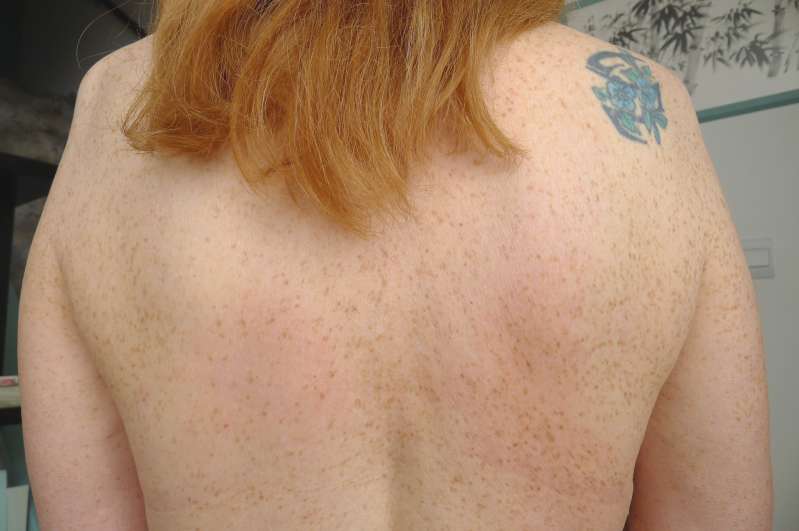 | ||
| 17/10/2012: Skin improving after stopping recommended aqueous cream |
Friday, 14 September 2012
In Trouble Again
It's Friday. I've calmed down somewhat from the stress of earlier in the week, and I'm getting used to the routine. I turn up, wait in the big waiting room, then the radiographer (who always introduce themselves, first name terms, which is nice: Kathryn or Pira or Claire or Colin or...) take me through to the little waiting area. Then it's through the double doors, round the bendy corridor to the RT machine. Kit off, on couch, some realingment of me on the couch then ZAP!!

But on Friday I went through the bendy corridor to the RT machine and saw two people I'd never met before (a man and a young woman) standing in a corner. She was doing stuff, while he watched. I waited.
After a moment, the radiographer said, "Are you all right Carol?"
I replied, "I'm sorry, I just don't like getting undressed in front of people who haven't introduced themselves."
I got sent to the naughty room.
Of course I didn't. The radiographer introduced them immediately, I got my kit off... all continued as normal.
But it was interesting to note that the 2 newbies were a student radiographer and her male trainer. What? Courtesy and respect weren't part of that module?

But on Friday I went through the bendy corridor to the RT machine and saw two people I'd never met before (a man and a young woman) standing in a corner. She was doing stuff, while he watched. I waited.
After a moment, the radiographer said, "Are you all right Carol?"
I replied, "I'm sorry, I just don't like getting undressed in front of people who haven't introduced themselves."
I got sent to the naughty room.
Of course I didn't. The radiographer introduced them immediately, I got my kit off... all continued as normal.
But it was interesting to note that the 2 newbies were a student radiographer and her male trainer. What? Courtesy and respect weren't part of that module?
Wednesday, 12 September 2012
Trust Me I'm a Doctor: Part 1
I was stressed going in Monday morning, 10th September. Partly because I was on my way to my first radiotherapy session, again: scary. Also because the appointment time had been changed as “Dr Carnell would like a word first”. No-one likes to hear the phrase “The doctor would like to see you” – it’s inherently scary, too. Still, Godfrey and I reasoned that she probably just wanted to apologise after the balls up last week. Dr Carnell’s Registrar Dr Khan plain forgot to let us know the first treatment the previous Monday had been cancelled, and so we wasted a fraught trip to London to face the unknowns of radiotherapy for nothing.
An apology? What were we thinking? Dr Carnell explained the reason she wanted to see me was that the proposed treatment had been changed. The only thing she said, to acknowledge the grief we'd been put through, was “I gather you were messed around last week, but I wasn’t here” Hmmm. I always thought that the buck stopped with the Head of the Clinical Firm, and ultimately the actions of any of the staff in the firm lay with the Consultant in charge regardless of whether they were in the vicinity.
When Godfrey and I first met Dr Carnell, around 6 weeks post-surgery, she said I needed to have the perimeter of my right lung bathed in radiation using IMRT “which is ideal for this kind of situation”. She described in glowing terms (oh yes, pun definitely intended!) the benefits of IMRT over the conventional, conformal radiation and explained how rogue cancer cells could be lurking anywhere where the tumour had touched my lung or chest wall. That’s a big area: from my collar bone down to the base of my ribs, then sweeping out to the right.
She explained that side effects with IMRT are in general, less severe than for conformal radiation. The radiation is beamed at the target areas from thousands of different directions which means they are able to more effectively avoid healthy tissue and vital organs. The process was well suited to treating concave surface areas such as the interior of the chest wall, and also where there is constant movement. When I went in for the planning meeting a week or so later, one of the things they did was study my breathing pattern. It all made sense.

Moving on to Monday, at the quick meeting squeezed in immediately before the first treatment, and Dr Carnell explains the real reason for the delay in starting my treatment. In planning the IMRT the physicists had realised that there was a significant risk of something called ‘radiation pneumonitis’ (RP). This is basically an inflammatory process in the lungs which in the worst cases can lead to scarring and fibrosis in both lungs, with people ending up as a “respiratory cripple”. So instead, my treatment plan had been revised, meaning the planning had to be re-done using conformal radiation: “back to the old-fashioned way. Any questions?”
“Errr, what is a respiratory cripple? Sounds like something to be avoided”. “Yes” chipped in the RT department nurse, also in the room and up until then, silent. “I’ve seen it, it’s not something you want to have.”
“Which is why we want to change the plan” explained Dr Carnell, pushing the amended consent form towards me.
“Do you want me to re-sign that?” I asked
“Doesn’t really matter, I’m a witness” said the nurse, sitting on the treatment couch, observing.
I was feeling confused, Godfrey sensed an information vacuum.
“What about the side effects? “ he asked.
”About the same” replied Dr Carnell.
“What about the scarring on the heart?”
“About the same.”
“What about the lungs?”
“About the same.”
Getting information out of this woman was like getting blood out of a stone.
“What about Carol’s oesophagus?”
“The side effects on the oesophagus might be a bit worse, you might need to avoid firm food for a while.”
“Will it recover?”
“Oh yes, after a few weeks.”
The nurse chipped in, “In any case, we can treat that. We can give you things to ease the symptoms”.
Godfrey was still puzzled at the change in the modality. Dr Carnell said they'd tried several times with the IMRT approach, but nothing was safe. Conformal radiation seemed to be the best bet. "The optimal solution?" he asked. "Yes."
So I signed, and we waited for the first treatment. As we waited, we tried to take in the salient points of the lightning quick consultation. Godfrey was saying, there’s something wrong, this doesn’t sit right. He sensed a lot of defensiveness. It wasn’t so much what was being said, as what wasn’t being said. Afterwards, he began to get more and more concerned. “This doesn't make sense” he was saying “Why did we get all this spiel about how IMRT was so much better, only for Dr Cornell to tell us now, at the last possible moment, that you’re going to have the old fashioned treatment? How can it be that IMRT’s ideal for treating you one day, and now it could virtually kill you? The medical staff must have known this was the intention when they cancelled last weeks’ appointment, why didn’t they say anything earlier? Why bounce us like that? How come Dr Carnell doesn’t take responsibility for not letting us know about the delay in treatment? So what that she wasn’t here, isn’t she responsible for her staff?”
By the time we got home, Godfrey was bouncing off the ceiling with worry and fury. We looked up RP, and ye gods, it definitely is something to be avoided. In essence, your lungs become leathery and fibrotic and can no longer do the oxygen exchange thing. You can reach a point where you can’t breathe at all, and die. It’s irreversible. A small section of lung can be affected initially, then it can spread through that lung and even into the other side. If you don’t die, you’re on oxygen, gasping for breath, unable to walk more than a few yards.

There are 5 grades of RP:
1) Mild dry cough not requiring treatment
2) Cough requiring narcotic cough medicine or breathing difficulties during activity
3) Severe cough not responsive to narcotics and breathing difficulties when resting, intermittent oxygen or steroids may be required
4) Continuous oxygen or assisted ventilation
5) Fatal
I don't want to be unfair to anyone in this blog, but I do want to be true to my emotional state."State" being the operative word. The more we looked into RP, the worse it got. Some of what follows is, with hindsight, a bit blamey, a but harsh. But that is how I was feeling.
Recent thoracic oncology papers state that 5 - 15% of people treated with RT to the chest area get RP: that’s including lung, breast, oesophageal cancer etc. Not all of them get it severely: sometimes it’s just mild breathlessness or a cough, and sometimes when it’s mild it goes away again. The danger of getting severe RP (Grade 2 or higher) might be an acceptable risk when you have something terminal. But I don’t. Not at the moment, now the thymoma’s been removed. All I have is a few slow growing cells at the end of a minor blood vessel.
RP is caused by the RT: your chances of getting it vary with the total dose, the volume of lung treated, the fraction size and whether or not you receive chemo at the same time. The critical dosage is 45 Gy: I’m to have 50.4. Over a wide area. And, it’s caused just as much by conformal radiation as IMRT.
We’d been worried about the seemingly extensive nature of the IMRT: I get in principle how it would work for a solid tumour, but couldn’t see how it could be used to treat the ‘rind’ as they call it, where the lungs lie against the chest wall, without doing damage to a load of lung tissue. I’d put my worries down to not understanding fully. Now though, it seems I was right: how come I instinctively knew that, but Dr Carnell, with all her qualifications and experience, didn’t?
We began to play back our previous meeting in our minds, and realised that we didn’t really like what we remembered. When I’d asked questions on our first meeting in the Macmillan Centre on the 6th August, she’d said “it’s all very complicated, you need to have studied oncology for 6 or 7 years to understand this stuff.” I was somewhat taken aback by her seemingly paternalistic and patronising tone. She also pulled me up when I mispronounced a technical word, like I was some hapless medical student. Today, she’d seemed less than open when answering Godfrey’s questions, and not really explained the reasons behind the change in treatment modality. We couldn't understand how the side effects I was now facing from conformal radiation would be "about the same" as before, since one of the benefits of IMRT was said to be less severe side effects. Dr Carnell hadn’t felt the need to apologise for the anxiety and stress caused by her staff not telling us of the changed start date. She’d seen us alone the first time, this time she’d organised a witness.

There's a feeling you get sometimes, when someone's giving you unexpected news.It's hard to put your finger on: but there's a sense that words are being used in a very particular way, and meanings are shifting. You run the script back through your mind,and everything seems to be correct, yet the sense is you're in trouble. There was something of that going on in the meeting today, a sense of manipulation; a lack of a true connection.
The only outright euphemism I spotted during the meeting was the nurse saying, "we can treat that", for oesophagitis. Yeah,right. So can a crystal healer, or a reflexologist. The question isn't whether it can be treated, but whether it can be cured. But, as Quentin Crisp said, "Euphemisms are not, as many young people think, useless verbiage for that which can and should be said bluntly; they are like secret agents on a delicate mission, they must airily pass by a stinking mess with barely so much as a nod of the head. Euphemisms are unpleasant truths wearing diplomatic cologne."
The fact that I was looking for euphemisms, for things unsaid, for half truths, for unexplored areas, says it all. I was panicking, and confused, and I had lost faith in my doctor.
STOP! I want to withdraw my consent to RT, altogether. I’ll take the risk of the tumour re-growing, thank you very much.
An apology? What were we thinking? Dr Carnell explained the reason she wanted to see me was that the proposed treatment had been changed. The only thing she said, to acknowledge the grief we'd been put through, was “I gather you were messed around last week, but I wasn’t here” Hmmm. I always thought that the buck stopped with the Head of the Clinical Firm, and ultimately the actions of any of the staff in the firm lay with the Consultant in charge regardless of whether they were in the vicinity.
When Godfrey and I first met Dr Carnell, around 6 weeks post-surgery, she said I needed to have the perimeter of my right lung bathed in radiation using IMRT “which is ideal for this kind of situation”. She described in glowing terms (oh yes, pun definitely intended!) the benefits of IMRT over the conventional, conformal radiation and explained how rogue cancer cells could be lurking anywhere where the tumour had touched my lung or chest wall. That’s a big area: from my collar bone down to the base of my ribs, then sweeping out to the right.
She explained that side effects with IMRT are in general, less severe than for conformal radiation. The radiation is beamed at the target areas from thousands of different directions which means they are able to more effectively avoid healthy tissue and vital organs. The process was well suited to treating concave surface areas such as the interior of the chest wall, and also where there is constant movement. When I went in for the planning meeting a week or so later, one of the things they did was study my breathing pattern. It all made sense.
Moving on to Monday, at the quick meeting squeezed in immediately before the first treatment, and Dr Carnell explains the real reason for the delay in starting my treatment. In planning the IMRT the physicists had realised that there was a significant risk of something called ‘radiation pneumonitis’ (RP). This is basically an inflammatory process in the lungs which in the worst cases can lead to scarring and fibrosis in both lungs, with people ending up as a “respiratory cripple”. So instead, my treatment plan had been revised, meaning the planning had to be re-done using conformal radiation: “back to the old-fashioned way. Any questions?”
“Errr, what is a respiratory cripple? Sounds like something to be avoided”. “Yes” chipped in the RT department nurse, also in the room and up until then, silent. “I’ve seen it, it’s not something you want to have.”
“Which is why we want to change the plan” explained Dr Carnell, pushing the amended consent form towards me.
“Do you want me to re-sign that?” I asked
“Doesn’t really matter, I’m a witness” said the nurse, sitting on the treatment couch, observing.
I was feeling confused, Godfrey sensed an information vacuum.
“What about the side effects? “ he asked.
”About the same” replied Dr Carnell.
“What about the scarring on the heart?”
“About the same.”
“What about the lungs?”
“About the same.”
Getting information out of this woman was like getting blood out of a stone.
“What about Carol’s oesophagus?”
“The side effects on the oesophagus might be a bit worse, you might need to avoid firm food for a while.”
“Will it recover?”
“Oh yes, after a few weeks.”
The nurse chipped in, “In any case, we can treat that. We can give you things to ease the symptoms”.
Godfrey was still puzzled at the change in the modality. Dr Carnell said they'd tried several times with the IMRT approach, but nothing was safe. Conformal radiation seemed to be the best bet. "The optimal solution?" he asked. "Yes."
So I signed, and we waited for the first treatment. As we waited, we tried to take in the salient points of the lightning quick consultation. Godfrey was saying, there’s something wrong, this doesn’t sit right. He sensed a lot of defensiveness. It wasn’t so much what was being said, as what wasn’t being said. Afterwards, he began to get more and more concerned. “This doesn't make sense” he was saying “Why did we get all this spiel about how IMRT was so much better, only for Dr Cornell to tell us now, at the last possible moment, that you’re going to have the old fashioned treatment? How can it be that IMRT’s ideal for treating you one day, and now it could virtually kill you? The medical staff must have known this was the intention when they cancelled last weeks’ appointment, why didn’t they say anything earlier? Why bounce us like that? How come Dr Carnell doesn’t take responsibility for not letting us know about the delay in treatment? So what that she wasn’t here, isn’t she responsible for her staff?”
By the time we got home, Godfrey was bouncing off the ceiling with worry and fury. We looked up RP, and ye gods, it definitely is something to be avoided. In essence, your lungs become leathery and fibrotic and can no longer do the oxygen exchange thing. You can reach a point where you can’t breathe at all, and die. It’s irreversible. A small section of lung can be affected initially, then it can spread through that lung and even into the other side. If you don’t die, you’re on oxygen, gasping for breath, unable to walk more than a few yards.
There are 5 grades of RP:
1) Mild dry cough not requiring treatment
2) Cough requiring narcotic cough medicine or breathing difficulties during activity
3) Severe cough not responsive to narcotics and breathing difficulties when resting, intermittent oxygen or steroids may be required
4) Continuous oxygen or assisted ventilation
5) Fatal
I don't want to be unfair to anyone in this blog, but I do want to be true to my emotional state."State" being the operative word. The more we looked into RP, the worse it got. Some of what follows is, with hindsight, a bit blamey, a but harsh. But that is how I was feeling.
Recent thoracic oncology papers state that 5 - 15% of people treated with RT to the chest area get RP: that’s including lung, breast, oesophageal cancer etc. Not all of them get it severely: sometimes it’s just mild breathlessness or a cough, and sometimes when it’s mild it goes away again. The danger of getting severe RP (Grade 2 or higher) might be an acceptable risk when you have something terminal. But I don’t. Not at the moment, now the thymoma’s been removed. All I have is a few slow growing cells at the end of a minor blood vessel.
RP is caused by the RT: your chances of getting it vary with the total dose, the volume of lung treated, the fraction size and whether or not you receive chemo at the same time. The critical dosage is 45 Gy: I’m to have 50.4. Over a wide area. And, it’s caused just as much by conformal radiation as IMRT.
We’d been worried about the seemingly extensive nature of the IMRT: I get in principle how it would work for a solid tumour, but couldn’t see how it could be used to treat the ‘rind’ as they call it, where the lungs lie against the chest wall, without doing damage to a load of lung tissue. I’d put my worries down to not understanding fully. Now though, it seems I was right: how come I instinctively knew that, but Dr Carnell, with all her qualifications and experience, didn’t?
We began to play back our previous meeting in our minds, and realised that we didn’t really like what we remembered. When I’d asked questions on our first meeting in the Macmillan Centre on the 6th August, she’d said “it’s all very complicated, you need to have studied oncology for 6 or 7 years to understand this stuff.” I was somewhat taken aback by her seemingly paternalistic and patronising tone. She also pulled me up when I mispronounced a technical word, like I was some hapless medical student. Today, she’d seemed less than open when answering Godfrey’s questions, and not really explained the reasons behind the change in treatment modality. We couldn't understand how the side effects I was now facing from conformal radiation would be "about the same" as before, since one of the benefits of IMRT was said to be less severe side effects. Dr Carnell hadn’t felt the need to apologise for the anxiety and stress caused by her staff not telling us of the changed start date. She’d seen us alone the first time, this time she’d organised a witness.

There's a feeling you get sometimes, when someone's giving you unexpected news.It's hard to put your finger on: but there's a sense that words are being used in a very particular way, and meanings are shifting. You run the script back through your mind,and everything seems to be correct, yet the sense is you're in trouble. There was something of that going on in the meeting today, a sense of manipulation; a lack of a true connection.
The only outright euphemism I spotted during the meeting was the nurse saying, "we can treat that", for oesophagitis. Yeah,right. So can a crystal healer, or a reflexologist. The question isn't whether it can be treated, but whether it can be cured. But, as Quentin Crisp said, "Euphemisms are not, as many young people think, useless verbiage for that which can and should be said bluntly; they are like secret agents on a delicate mission, they must airily pass by a stinking mess with barely so much as a nod of the head. Euphemisms are unpleasant truths wearing diplomatic cologne."
The fact that I was looking for euphemisms, for things unsaid, for half truths, for unexplored areas, says it all. I was panicking, and confused, and I had lost faith in my doctor.
STOP! I want to withdraw my consent to RT, altogether. I’ll take the risk of the tumour re-growing, thank you very much.
Trust Me I’m a Doctor: Part 2
By Tuesday morning, after a sleepless night, I’d decided. Unless I got some answers, I was going to pull out of the radiotherapy.
I rang the hospital and asked for an urgent appointment with Dr Carnell, to try and get those answers. She agreed to see me at 1 pm, before my scheduled 2nd treatment at 1.30.
Because of my NHS experience, I’ve met loads of doctors over the years. Most of the doctors I’ve met have been extremely bright and totally committed to doing the best for their patients. Many have been funny, warm, and thoughtful as well. Many are also big-headed: but personally, I accept that as part of the package. You need a certain amount of self-belief if you’re going to cut people open or prescribe poisons for a living.
Being bright, committed and even a bit egotistical doesn’t make them infallible. Every week in the press there’s stories about clinical mistakes. Of course, I do understand that the reason these stories make good copy is that mistakes are relatively rare. I also understand that in RT more than almost anywhere else there’s controls: double checking of plans, calibration of machines, routine monitoring of dosages, regular scans: all possible steps are taken to eliminate error.
I've absolutely no doubt about the skills, knowledge and experience of Dr Carnell. Still though, at heart the decision to treat or not to treat, to handle things this way as opposed to that way, these are all judgements. I want to be included in those judgements. No-one (except Godfrey) has my interests at heart as much as I do. The chances are that I’ll agree with whatever decisions are being made, but I want to be part of the decision up front. I don’t want to wait till afterwards and then complain.
The thing is, I've thought a lot about life, and death, and that grey area in between. I spent a year working as a care assistant for severely physically disabled people. I'm talking about people who, in the main, were fully aware, had normal cognitive ability but no motor control. Think 'locked in syndrome'. Most couldn't speak, couldn't move their arms or legs, and were doubly incontinent. Most couldn't swallow so couldn't eat. Some had degenerative conditions and would die young, some had a normal lifespan. They were there because of MS, or strokes, or an anaesthetic accident, or head injury. I'd rather die than live like that.
So when it comes to clinical outcomes, I'm not interested in pure survival rates. I'm interested in quality of life. I would rather live well for the next 10 years then die prematurely of cancer, than live out a normal lifespan with severely compromised breathing..
I can understand doctor-speak, at least a little. I’m used to being treated by doctors as a colleague, and can’t and won’t accept being treated as a know-nothing patient. Doctors however, are not used to treating patients as colleagues. So Dr Carnell and I might have a communication problem. I’m sure it will be resolved, but there’ll be some difficult moments in the meantime.
I sensed that Dr Carnell and I could be heading for one of those difficult moments.
Godfrey and I had decided that we wanted 4 other options to at least be discussed:
- Watch and wait.
- Treat just the pedicle: the surgical margin - where we know there are cancer cells.
- Treat the pedicle and the area immediately adjacent, and maybe the biopsy site.
- Seek a second opinion.
Was I being a fool, everyone else in the world would just shut up and take what was on offer, what did I know, who am I to question a consultant, did I know how lucky I was to even be able to access treatment, supposing I do refuse treatment and it comes back: I’ll kick myself ………………..and
 |
| Not inspirational |
I can’t cope with this, I’m going to make a fool of myself, I haven’t had to strut my managerial stuff in years and don’t know if I can still hack it, I’m panicking, I’m going to cry.
When I got there, Dr Carnell was in a clinic room with another of her registrars, Dr Ball. “Need another witness, do you?” I thought.
I started off by explaining that I knew UCH, and the Oncology department, was on top of its game. That the excellent results they produced were a direct consequence of the aggressive approach they took to cancer, and that it was precisely for that reason I had wanted to be treated there. Then I said “You seem to be treating my tumour as aggressively as if it were lung cancer. If it had been lung cancer, then the risk of side effects such as Radiation Pneumonitis (RP) might be worth it. But it’s not. I had a slow growing, semi-malignant thymoma, which has been excised. Why can’t we just keep an eye on me, and if the tumour comes back, excise it again?”
Dr Carnell explained that it was precisely because the tumour was slow-growing that it needed to be treated so soon, and so aggressively. Where the residual cells are, right up against major blood vessels and my heart, would make future surgery very problematic. The best option is preventative. RT works best on fast growing cells: thymomas do not respond well to RT. Waiting for it to grow and then zapping it would not be straightforward. “The time to treat it is now, when there’s only a few cells involved.”
“But the standard treatment for Thymoma is excision, not excision plus adjuvant RT.”
“Yes, but yours could not be completely excised, there are still cells at the margin. And because you are so young, it will re-grow enough to cause problems later in life.”
I knew about the incomplete excision and regrowth, of course. Hadn’t realised about the complexities of future surgery. So it looked like ‘watch and wait’ was not as simple as it sounded. But still, the innocently named “side effects” terrified me.
“So, if we need RT, I’m very worried about the potential for severe RP. This hasn’t been mentioned before. I’d rather not be treated and take my chances, than have any risk of that.”
“Yes,” Dr Carnell replied ”It’s precisely to avoid that that the treatment protocol has changed. The revised approach is to irradiate just the tumour site and a very narrow column of lung immediately in front. There’ll be 3 beams of radiation precisely targeted towards the same area and the rest of your lung will be left clear. YOU WILL NOT GET RADIATION PNEUMONITIS”.
She said, “I don’t know what you’ve been reading, but really, you need to have studied oncology for six or seven years to understand properly what we are proposing to do. You just have to learn to trust me.”
I got cross. I don’t take well to being patronised. I’d heard the ‘years of training’ line before, and I wasn’t impressed. If the CERN Physicist Prof Brian Cox can explain the creation of the solar system with perfect clarity using a pepper pot, a sugar bowl and an ashtray, then I’m sure Dr Carnell could explain my treatment to me. Frankly, it's her job to explain things to non-specialists. That's what all professionals have to learn to do. Also, there's plenty of people like me, who want to understand what's going on and who don't want nursey reassurance. I'm quite capable of reassuring myself, if I have the information.
I said, “I’ve knocked around the NHS system for far too long to take any doctor on trust. Also, as to what I’ve been reading: I’ve not been in the chat rooms, I’ve been reading proper medical journals: the Journal of Thoracic Medicine, Journal of Oncology, BMJ: that sort of stuff. Probably some of the same stuff you’ve been reading.”
“I’m not stupid” I said, “I will understand if you explain”
Then she told me something I didn’t know: that UK treatment protocols were considerably more conservative than international standards. Therefore, a lot of the stuff I’d seen wasn’t comparable. OK, that was news, and reassuring news, to boot.
I asked for a drawing, and Dr Ball said he’d try to pull up the actual planning picture on the computer, if that would help. Very much, yes. In the meantime Dr Carnell drew a sketch, and I began to see what she was talking about. She was proposing to just treat the pedicle and the area immediately adjacent, in a slim column alongside my sternum. That’s OK. That was one of our preferred options. The big sweep across the whole lung had gone. I’m not sure what the plan is for any further microscopic tumour cells elsewhere in the pleural cavity, but I guess if they exist, and re-grow, they will be away from major vessels and will be operable. That’s for another day.
Why couldn’t she have said all this yesterday? The grief, the stress, the time spent reading medical journals, the sleeplessness, the worry, all could have been avoided with a full explanation up front. This extra appointment could have been avoided. Instead, we’ve had to spend half an hour having a meeting which must have been difficult for each of us, and I’m sure we both had better things to do.
Dr Ball couldn’t get the planning pictures up on the system, and suggested taking me to the planning offices to look at my images on their computers. Yes please. I felt the nerd in me rising up, excited. A chance to look at the RT planning process! Yippee!
 |
| Red Line Encircles Target Area: Excision Site, Heart and Anterior Chest Wall. |
I said, “Yes, but that means for every 1000 people you see with cancers in the chest, 50 of them will get RP. For each of them, they’ll get it 100%.” I know I’m stroppy. That doesn’t mean I’m wrong.
“But nearly all in a mild form, which is treatable. In all my years as a doctor, and all Dr Carnell’s years, neither of us has seen or heard of anyone getting it severely. You don’t need to worry about it.”
“Why’s it on the consent form, then, as a known side effect? Can it be taken off?”
“No, it still needs to be there because it is a risk. But a very small risk.”
OK then. now I understand what's intended and I'm less anxious, I’ll accept a very small risk.
I’m going to remember the words of Dr Carnell :
"YOU WILL NOT GET RADIATION PNEUMONITIS".
We’ll see.
Meantime, I’ll work on my trust issues.
Wednesday, 5 September 2012
WTF???
It’s Monday morning and Radiotherapy (RT) starts today. I’m anxious, of course.
I’ve been anxious since we were first told I needed RT. It’s the radiotherapy itself, the relentless draining of my energy, the sunburn, the possibility of side effects, the huge unknown-ness of the process. And the worry that despite all the best efforts of the staff, some cells will still be missed and we’ll be back to the beginning all over again. That and the travelling, the mind-numbing exhaustion of commuting into London 5 times a week with hordes of strangers. The delays and breakdowns, and the sweaty heat, and fast food smells, and the screeching of the brakes and umbrellas dripping on my feet and the lack of space and the noise.
I’m also scared of how I’m going to feel. I don’t like the feeling that as time goes on, I’m going to get gradually weaker and weaker. It feels as though I’m just starting to get myself back together after the operation, and I’m not ready to go back to being an invalid again. Not yet.
Going into London for RT is not like going into Brentwood for shopping. It’s a big deal. Comes with a whole stash of fears and anxieties, some rational, some not. My everyday mental filters dissolved away and all those 4-in-the-morning worries and questions started blipping through my mind, unchecked. Here’s a selection:
“What if the staff get the dosage wrong? I’m going to die.”
“How will I cope with all of this treatment? I don’t have the strength.”
“I can’t deal with this commuting. There’s too many people and too much noise.”
“What if my heart or lugs are damaged? I’ll end up an invalid. I’m too young to be an invalid and way too old to start wheelchair racing”
“What if I panic and start to cry?”
“I’m going to see the same staff every day for weeks. I need them to like me. What if they don’t like me? What if I don’t like them?”
“I hope they know what they’re doing.”
“Supposing the machine’s calibrated wrong? The first we’ll know of it is the smell of burning…..”
“I’m going to meet the same group of other patients every day in the waiting area. What if one of them latches on to me? How do I get rid of them without being rude? Does it matter if I am rude? Will I latch on to someone else, and they’ll have to get rid of me? Should I just hide in a corner with a book? What are the rules for all this?”
“I’m going to feel so ill; I’ve barely got over the surgery…”
“How am I going to cope, especially once I start getting tired?”
“I hate the aqueous cream I’m using on my skin. It reminds me of when I had eczema, smells medicalised and I don’t feel clean.”
“If that woman on the mobile phone behind me doesn’t SHUT UP I’m going to have to kill her”
“What if the RT doesn’t work? I’ll have gone through all of this and have to go through it, and worse, all over again.”
“Everyone else copes, why am I such a wimp?”
Still, whenever a challenge has come along in my life I’ve never been ready. Just like everyone else. Somehow, we all have to just reach down inside ourselves and find the strength to deal with it. But it’s not easy, it does take a certain girding of loins, a gritting of teeth, and a conscious putting of the fear to one side. You just have to rise to the occasion.
When we got to the RT department, we waited with trepidation for a few minutes, then we were called in to meet the radiographer. “Hello” she said, “My name’s Kathryn. We’re surprised to see you here today, your appointment’s been cancelled. Dr Khan was supposed to call you, but I’m guessing that as you’re here, you didn’t get the message.”
WTF? I reeled in disbelief. “Why?”
“The treatment planning is taking longer than expected, and the medical physicist hasn’t finalised his workings yet. You’ve been re-scheduled for next week.”
There’s nothing you can say or do at times like this that make any sense. Clearly there was a fuckup, but it wasn’t Kathryn’s fault: the blame lies with Dr Khan. She was nowhere to be seen.
I felt like just walking out, slamming the door behind me like a petulant child. But I was too confused, and too polite. And hospital doors don’t slam effectively anyway, they kind of glide shut. Also, I thought there must be questions to ask: but I couldn’t think of any. Godfrey managed to avoid an awkward silence, by asking what had happened, why the treatment planning was taking so long. Kathryn didn’t really know, but it was clear that the hospital knew some time last week that the treatment wasn’t going to happen, and had delegated a member of the team to liaise with me, and it seemed likely to us that she’d just plain forgot.
I pulled myself together somewhat, and was able to bleat out a few comments about how stressful this trip had been, and how having got myself into treatment gear, it was extremely distressing to then be sent home untreated. Kathryn replied that the hospital might refund the ticket costs, seeing as it was their mistake. “But you can’t refund the stress though, can you” I said. Nope.
So that was that. We left.
It was only afterwards that we began to process what had just happened. Back on the tube and train again, back into the auditory nightmare that is modern commuting, the babel of voices, the shrill ringtones, the relentless chundering of the wheels and the mind-numbing repetitiveness of the station announcements. Godfrey and I can’t talk to each other much over the cacophony so we sit in silence, with all the uncertainties and questions we had on the way in plus some new ones:
“How come the RT, which was urgent 3 weeks ago, can now wait another week? Won’t the delay mean the cells are still growing? What if some of them use this extra week to slough off away from the treatment area and move into the other lung? Or elsewhere? How’s anyone going to know?”
And “If a doctor can’t be bothered to make a simple phone call, what else can’t she be bothered to do? “
And “Why is it taking longer than expected to plan this. They knew exactly what my situation was when the first appointment was made. Have they found something unexpected? What are they not telling me?
And “Why on earth is the doctor the person who’s supposed to call me to tell me the appointment’s been moved? Haven’t they got more important stuff to do? Why is it a doctors job anyway, appointments are an admin thing and she's a highly qualified technical wonk, completely the wrong person. Couldn’t the receptionist have done it? It’s only a bloody phone call, for God’s sake.”
And “Those cells are growing, right now. I can feel them. “
And “Why are the trains so busy at 3.30 on a Monday afternoon. I can’t bear all these people around me. If that woman on the mobile doesn’t shut up I really am going to have to kill her.”
And, because anxiety makes me feel scared, and fear makes me hostile, “Who are all these people? What are these languages being spoken? They’re not tourists, and they’re not poor, they’ve got top of the range mobiles and plenty of bling, why are they even here taking up all the room in this carriage and squeezing me out?”
On Tuesday, Dr Khan did manage to call me, to apologise. So that was all right then. Forgiven and forgotten. Actually, no. I hate this modern trend for apologies making everything OK. That works when you’re 4 years old and learning contrition, but for grown-ups, it just doesn’t wash. So although I accepted her apology – what else could I do? – I tried to make her understand how exhausting and draining the whole situation had been, in the hope that she would decide she never wanted to have such a conversation again: and so next time, she’d remember to make the phone call.
On Friday, we’ll call the hospital and check that the appointment is real, then no doubt the build up of anxiety will start all over again. Happy days.
I’ve been anxious since we were first told I needed RT. It’s the radiotherapy itself, the relentless draining of my energy, the sunburn, the possibility of side effects, the huge unknown-ness of the process. And the worry that despite all the best efforts of the staff, some cells will still be missed and we’ll be back to the beginning all over again. That and the travelling, the mind-numbing exhaustion of commuting into London 5 times a week with hordes of strangers. The delays and breakdowns, and the sweaty heat, and fast food smells, and the screeching of the brakes and umbrellas dripping on my feet and the lack of space and the noise.
 |
| Faceless people crowding in |
I’m also scared of how I’m going to feel. I don’t like the feeling that as time goes on, I’m going to get gradually weaker and weaker. It feels as though I’m just starting to get myself back together after the operation, and I’m not ready to go back to being an invalid again. Not yet.
Going into London for RT is not like going into Brentwood for shopping. It’s a big deal. Comes with a whole stash of fears and anxieties, some rational, some not. My everyday mental filters dissolved away and all those 4-in-the-morning worries and questions started blipping through my mind, unchecked. Here’s a selection:
“What if the staff get the dosage wrong? I’m going to die.”
“How will I cope with all of this treatment? I don’t have the strength.”
“I can’t deal with this commuting. There’s too many people and too much noise.”
“What if my heart or lugs are damaged? I’ll end up an invalid. I’m too young to be an invalid and way too old to start wheelchair racing”
“What if I panic and start to cry?”
“I’m going to see the same staff every day for weeks. I need them to like me. What if they don’t like me? What if I don’t like them?”
“I hope they know what they’re doing.”
“Supposing the machine’s calibrated wrong? The first we’ll know of it is the smell of burning…..”
“I’m going to meet the same group of other patients every day in the waiting area. What if one of them latches on to me? How do I get rid of them without being rude? Does it matter if I am rude? Will I latch on to someone else, and they’ll have to get rid of me? Should I just hide in a corner with a book? What are the rules for all this?”
“I’m going to feel so ill; I’ve barely got over the surgery…”
“How am I going to cope, especially once I start getting tired?”
“I hate the aqueous cream I’m using on my skin. It reminds me of when I had eczema, smells medicalised and I don’t feel clean.”
“If that woman on the mobile phone behind me doesn’t SHUT UP I’m going to have to kill her”
“What if the RT doesn’t work? I’ll have gone through all of this and have to go through it, and worse, all over again.”
“Everyone else copes, why am I such a wimp?”
Still, whenever a challenge has come along in my life I’ve never been ready. Just like everyone else. Somehow, we all have to just reach down inside ourselves and find the strength to deal with it. But it’s not easy, it does take a certain girding of loins, a gritting of teeth, and a conscious putting of the fear to one side. You just have to rise to the occasion.
When we got to the RT department, we waited with trepidation for a few minutes, then we were called in to meet the radiographer. “Hello” she said, “My name’s Kathryn. We’re surprised to see you here today, your appointment’s been cancelled. Dr Khan was supposed to call you, but I’m guessing that as you’re here, you didn’t get the message.”
WTF? I reeled in disbelief. “Why?”
“The treatment planning is taking longer than expected, and the medical physicist hasn’t finalised his workings yet. You’ve been re-scheduled for next week.”
There’s nothing you can say or do at times like this that make any sense. Clearly there was a fuckup, but it wasn’t Kathryn’s fault: the blame lies with Dr Khan. She was nowhere to be seen.
I felt like just walking out, slamming the door behind me like a petulant child. But I was too confused, and too polite. And hospital doors don’t slam effectively anyway, they kind of glide shut. Also, I thought there must be questions to ask: but I couldn’t think of any. Godfrey managed to avoid an awkward silence, by asking what had happened, why the treatment planning was taking so long. Kathryn didn’t really know, but it was clear that the hospital knew some time last week that the treatment wasn’t going to happen, and had delegated a member of the team to liaise with me, and it seemed likely to us that she’d just plain forgot.
I pulled myself together somewhat, and was able to bleat out a few comments about how stressful this trip had been, and how having got myself into treatment gear, it was extremely distressing to then be sent home untreated. Kathryn replied that the hospital might refund the ticket costs, seeing as it was their mistake. “But you can’t refund the stress though, can you” I said. Nope.
So that was that. We left.
It was only afterwards that we began to process what had just happened. Back on the tube and train again, back into the auditory nightmare that is modern commuting, the babel of voices, the shrill ringtones, the relentless chundering of the wheels and the mind-numbing repetitiveness of the station announcements. Godfrey and I can’t talk to each other much over the cacophony so we sit in silence, with all the uncertainties and questions we had on the way in plus some new ones:
“How come the RT, which was urgent 3 weeks ago, can now wait another week? Won’t the delay mean the cells are still growing? What if some of them use this extra week to slough off away from the treatment area and move into the other lung? Or elsewhere? How’s anyone going to know?”
And “If a doctor can’t be bothered to make a simple phone call, what else can’t she be bothered to do? “
And “Why is it taking longer than expected to plan this. They knew exactly what my situation was when the first appointment was made. Have they found something unexpected? What are they not telling me?
And “Why on earth is the doctor the person who’s supposed to call me to tell me the appointment’s been moved? Haven’t they got more important stuff to do? Why is it a doctors job anyway, appointments are an admin thing and she's a highly qualified technical wonk, completely the wrong person. Couldn’t the receptionist have done it? It’s only a bloody phone call, for God’s sake.”
And “Those cells are growing, right now. I can feel them. “
And “Why are the trains so busy at 3.30 on a Monday afternoon. I can’t bear all these people around me. If that woman on the mobile doesn’t shut up I really am going to have to kill her.”
And, because anxiety makes me feel scared, and fear makes me hostile, “Who are all these people? What are these languages being spoken? They’re not tourists, and they’re not poor, they’ve got top of the range mobiles and plenty of bling, why are they even here taking up all the room in this carriage and squeezing me out?”
On Tuesday, Dr Khan did manage to call me, to apologise. So that was all right then. Forgiven and forgotten. Actually, no. I hate this modern trend for apologies making everything OK. That works when you’re 4 years old and learning contrition, but for grown-ups, it just doesn’t wash. So although I accepted her apology – what else could I do? – I tried to make her understand how exhausting and draining the whole situation had been, in the hope that she would decide she never wanted to have such a conversation again: and so next time, she’d remember to make the phone call.
On Friday, we’ll call the hospital and check that the appointment is real, then no doubt the build up of anxiety will start all over again. Happy days.
Wednesday, 27 June 2012
Safety, Kindness, Teamwork & Improving
I’m recovering well from the surgery. That’s the main thing, the most important thing. It would be nice if I was also full of a warm fuzzy glow because of the kindness and care of the staff at the Heart Hospital. Sadly, that’s not the case.
It’s taken me a long time to write this. I’ve been home for 10 days, it’s a fortnight since the operation, and I’m still wondering whether I should say publicly some of the things that happened, or just let it go. The truth is, most people coming out of hospital put the horrible things that have happened behind them and move on, and I understand why they do. But as a result, the situation doesn’t improve. The UCLH values are “safety, kindness, teamwork and improving” and my reflections on my care are germane to each of those values. Also, I shared my side room with 2 other patients, both of whom were brought near to tears with frustration and fury at the way they were treated. Bear in mind this is the Heart Hospital: you would think that raising the blood pressure of patients would be contra-indicated. So I think I will publish, and see what happens.
None of the stuff that went wrong was complicated. It was all really basic nursing and surgical care, and organisational management. There is frankly, no excuse.
Most of the time, there seemed to be a plan of what should happen to me. It’s just that very few took personal responsibility for delivering the plan. Most staff seemed happy to put the burden of doing things onto anonymous colleagues – “someone will be along in a minute to sort that out” was a constant refrain, which I eventually translated as “yes I know it needs to be done, but it’s not my job to do it.” However I never got the impression that the staff actually talked to each other about what was required: there was just an unspoken hope that someone else would pick up the ball they’d dropped. With the result that much of the time, things were left undone until I kicked up. I should just say that the housekeeping/domestic staff were lovely: friendly, thoughtful, kind and willing to help.
I’m not going to bore everyone with all the little niggles of conflicting advice, poor communications, lack of follow through etc. Godfrey’s blog entry on the admissions process: Personal v. Professional, conveys beautifully the chaos at ward level within the hospital. Instead, I’m just going to comment on several processes which could have had a material impact on my recovery. The fact that they didn’t is because I’m young, fit, knew what should happen and was sometimes capable of pushing the system to make sure it did happen.
Other times, though, I wasn’t capable. I’d just had major surgery, was confused, and weak, and vulnerable. My emotions were all over the place, minor things took on major importance and I couldn’t still the voices in my head that made everything feel like life or death decisions. For most of my stay I had chest drains in which caused a lot of discomfort and meant that even small things like getting in and out of bed, or to and from the bathroom, were a major exercise. I really, really wanted other people to look after me. That’s what I thought the nurses were for. Maybe I’m just old fashioned.
I do want to say that I have no complaints at all with one of the nurses, Esther, who was unfailingly friendly, kind and competent.
Apologies for the length of this entry.

Drain Removal
During the surgery I had 3 drains implanted taking fluid from my chest into some plastic bottles. Initially, the fluid was pumped out, later it just drained by gravity. The drains caused some pain and a great deal of discomfort, affected my ability to breathe fully and severely limited my mobility. Clinically, drains should be removed as soon as possible after the fluid has stopped draining, both to improve the patient’s comfort and mobility, and to prevent infection tracking back along the tube into the body cavity.
On Friday 15th June, 2 days post-surgery, the surgical registrar assessed whether the drains were still required. At least, that’s what it seemed like: she didn’t actually tell me anything, but she stood at the foot of the bed and asked me to cough, and then told the junior medics hovering in a nervous pack nearby that what she was seeing was different to what she expected, given my notes. “Cough” she said to me. “See how the tubes are swinging” she said to them. She told the attendant nurse that the mediastinal drain could come out but that an X-ray was required before a decision could be made on the others. Off they went. Later one of the juniors, so shy he could barely make eye contact, came back and told me I’d be taken downstairs for an X-ray later that morning.
An hour or so later Esther explained the procedure for drain removal to me, practised the breathing exercise two or three times and with a colleague, cleanly and efficiently removed the mediastinal drain. “You’ll have an x-ray later” she confirmed “before we can decide on the others, but at least you can move around now.” And I could, I was able to get back and forth to the loo carrying the remaining 2 bottles, and shuffle around the ward corridors.
As for the X-ray, no-one came. After lunch I asked when the X-ray would take place. “They’ll send someone for you this afternoon” I was told. No-one came.
The next day, there was no medical round, but the shy junior medic appeared and looked vaguely in the general direction of the drains from the foot of my bed. “We’ll get those out today” he said. “Don’t you need an X-ray first?” I asked. “Someone will come for you later this morning” he replied. No-one came.
After lunch, I had a word with Esther. She and I both agreed that as there was no significant fluid draining out any more, the drains could probably go. I said that I thought not getting the X-ray was delaying their removal. About half an hour later, a porter arrived to take me to X-ray, and the drains were removed at about 4.30 Saturday afternoon, 72 hours after surgery. Having a chest drain removed is the weirdest sensation I have ever experienced, but immediately I felt so much better. I could breathe fully, the pain and discomfort had gone and my energy levels picked up instantly. I rang Godfrey who had gone home after visiting, and he could hear in my voice how much better I was. But the most significant thing was, I could get about more freely. Mobilisation is really important after chest surgery, and now at last I was able to mobilise.
I was only in hospital for 4 days, one in ITU and 3 on the ward. The time on the ward was all about wound healing and mobilisation. In that context, the fact that it took from Friday morning to Saturday afternoon to get the X-ray which was a precursor to removing the drains, seems pretty inefficient. As a result, the stab wounds for the drains had less than 24 hours to heal before I was discharged. It seems pretty basic to me, that where there’s a clinical and operational need to get the patient mobile, the requisite investigations should take place promptly.
Nebuliser
Early on the Friday morning, my first morning on the ward, a nurse fitted a nebuliser at the side of my bed, behind my line of vision. “Someone will come along later and show you how to use this” she told me. On Friday, I was not a well person. I was still confused, dozy, unable to concentrate and vast tracts of time would just disappear as I drifted in and out of consciousness. I completely forgot about the nebuliser.
On the Saturday I saw it out of the corner of my eye, and remembered the nurse fitting it. I assumed it wasn’t important, otherwise someone surely would have come back and explained it to me. Because I’m registered asthmatic although I haven’t used an inhaler for maybe 20 years, I thought an over-conscientious nurse had probably provided one for me.
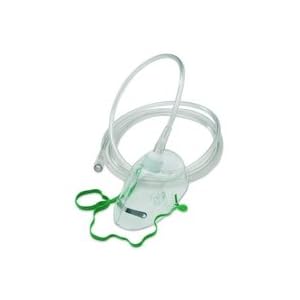
At 7 a.m., the same nurse returned, fitted it and told me what to do. “Keep going for 10 – 15 minutes” she said “and I’ll come back and see how you’re doing.” I never saw her again. After about half an hour I took it off myself. I didn’t cough during or after using it, and no-one ever mentioned it again.
I don’t know whether a nebuliser is essential post-operatively, or not. If it is, it should have been explained to me and I should have been enabled to use it. Otherwise, it should have been discussed as a treatment option. Instead, what I got was a physical piece of kit that I couldn’t use (because I didn’t know how to, and in any case couldn’t physically get to it for the first day and a half until the drains were removed) and a shed-load of fear that I was going to die because I hadn’t used it.
Dressings
Sunday morning: the drains came out the previous afternoon and this was my first chance to have a shower. Exciting! I still had gauze dressings on the upper part of my sternum, and over the drain site. I asked a nurse what to do, and she said to shower first and she’d come back in 10 minutes or so to change the dressings. Off I went to the shower, enjoying my drain-free movements. Still, though, showering is hard work. Everything aches. Bending down is a slow, carefully executed process. Putting on pyjamas takes thought. With a genuine sense of pride, I managed a successful shower and returned to my chair, complete with wet wound dressings.
20 minutes later, the nurse hasn’t returned so I decided to take the initiative and call someone to change the dressings. I could have pressed the buzzer, but I was supposed to be mobilising, so I decided to walk round to the nurses’ station. There were 3 or 4 nurses there doing nothing so far as I can see, but that’s OK, they’ve got to be somewhere between finishing one thing and starting the next. So I explained I’d just showered, and asked whether someone could come and sort out my dressings. “Go back to your room, someone will be there in a minute.” 25 minutes later, no-one had come. Worryingly, the drain wounds had begun to itch.
I think about at least removing the old dressings myself. But then I think, what if something goes wrong? The drains only came out yesterday afternoon, what if removing the dressing means the wounds start to bleed? What if blood clots from deep in the wound are adhering to the dressing and I pull them out as I remove it? What if there are signs of infection? You do hear these scare stories. To be honest, I also think, I’m the patient here. I’m getting better, so I’m getting angry.
I went back to the nurses’ station. Different people there now, but still about 3 or 4 of them, still apparently doing nothing. “Could someone please come and change my dressings?” I asked “I had a shower about 45 minutes ago, the dressings are wet and the wounds are starting to itch.” One of them glanced at my sternal dressing. “You can remove that one yourself” she said, with what felt like contempt. “And the dressing on the drain wounds?” I asked “The drains only came out yesterday, I thought you might at least want to see how they are healing...” “Go back to your room, someone will be there in a minute.”
This time, someone did come, and the dressings were changed, and all was well. But it might not have been. Dry dressings which have got wet with unsterile shower water are a breeding ground for bacteria, and when the wound goes right through into the chest cavity, the complications can be serious. The nurses didn’t know what was under the drain dressing, whether the wound was healing or not, whether there were signs of infection or otherwise. And what is worse, they didn’t seem to care.
Wearing a Bra
When you are a middle-aged top-heavy woman, your boobs naturally fall downwards and outwards, pulling away from the midline. It’s neither comfortable nor dignified, so I wear a bra.
When you have a sternotomy, your breastbone is cut in two along its length. Closure is performed by wiring the two halves together, and the skin is then glued back together again. You really don’t want unfettered boobs in these circumstances.
In fact, the guidance leaflet from UCH "Information for patients following a Sternotomy” says:
For women, do ensure that you wear a well supportive and comfortable bra (i.e. a sports bra). This will prevent your breasts pulling at your sternal wound. You will need to wear this from the day after surgery.
I didn’t get this leaflet until the Friday afternoon, 2 days after surgery, but luckily before I went into hospital I had researched my likely condition post-surgery and ensured I had a range of cotton, front fastening bras with me so that I could be comfortable afterwards.
So I asked in ITU whether I could put my bra on, and they said yes, fine, was it in my washbag? No, it was in my overnight bag, which was in storage and wouldn’t be brought to me until I got onto a proper ward. Shame no-one had pointed this out to me in Admissions, but hey. Never mind.
 |
| A Pillow for Support |
When I got onto the ward I couldn’t get out of bed: the chest drains were attached to the suction tubes. Never mind, the attentive admitting nurse was very helpful. I asked whether I could put a bra on, and he said “No. I don’t see how you can wear a bra with those drains in.” I only had the vaguest idea where the drains were, I was confused and exhausted and accepted his word. So I spent all that night and the next morning bra-less, trying to support myself with a pillow.
On the Friday, when the suction was stopped and one of the drains removed, I was finally able to get out of bed, find my overnight bag and put on a bra. The drains weren’t in the way, not even close to the bra line. Instantly, propriety and comfort were restored.
The point about the bra, though, isn't just my comfort. It's that heavy breasts pulling against a new wound could conceivably tear that wound open. Hence the guidance says, not that you might want to wear one, but that you will need to wear one from the day after surgery. How come the ward nurse doesn't know this? After all, I was in the Heart Hospital. You’d think the staff would be used to managing women post-sternotomy.
Discharge Process
Late morning on Sunday, a junior medic I’d never seen before came in to the room, looked at my notes, and without examining me, said I could go home. I waited for him to say tomorrow, or in the next day or so, but he meant now. He was being premature actually, as the established protocol after drain-removal includes a radiograph to detect any new fluid or air collection. This hadn't been done.
This was the first time anyone had mentioned discharge. I was stunned. I had been told the stay would be 5-7 days and it had barely been 4 days; the poxy drains had been out for less than 24 hours and so far, I hadn’t even ventured off the ward to see how far I could walk. I didn’t know if I could make it to the hospital shop, let alone get myself across the concourse of Liverpool St Station, through all the crowds. I was handed a piece of paper and told to get myself to X-ray for the final scan.
Instantly the doctor mentioned discharge, the atmosphere in the ward changed. The nurses, not exactly friendly in the first place, became downright cold. It was made clear that from now on I was in the way, I had shifted from patient to bed-blocker.
I rang Godfrey, who was still at home, planning to come and visit that afternoon, and told him I was coming home. He was stunned. “You’re not ready” he said, and I agreed. Still, we all know about pressure on beds, so we accepted the inevitable. I went downstairs and had the X-ray done, and came back.
It was lunchtime, so I ate and was resting in the chair after eating, then a nurse came in, sat on my bed and said, “Are you ready to go?” “I can’t go yet” I said, “I’m waiting for the results of the final X-ray”. “Only we need the bed, we’ve got someone else coming in” she said. And went. So, I packed up my stuff, called Godfrey again, and waited.
About an hour later, my bedside phone rang. It was one of the nurses saying the X-ray showed no effusion, so I could go now. I can’t leave just yet, I said, I can’t carry my own bags and my partner’s not here yet. “Where is he?” “On the tube, on his way” “When will he be here?” “I don’t know, I can’t contact him, he’s probably in a tunnel.” It’s a Sunday service on the trains: it takes as long as it takes. “Only we need the bed” she said.
OK, I said, could someone give me a hand with my bags? “Someone will come soon”, she said. I waited. After about half an hour, no-one had come. I walked round to the nurses’ station, the usual gaggle of 4 or 5 nurses there doing nothing, and I asked, “Could someone please come and help with my bags?” “Someone will be there soon” one of the nurses said without looking at me. I went back to my room.

About half an hour later, no Godfrey, no porter, no nurse, no contact from anyone. I was unhappy, and stressed, and not thinking clearly. Suddenly, I couldn’t stand it anymore. I’d had one too many “someone will be there soon”s. I needed to vacate the room, but couldn’t lift my own overnight bag, I’d just had a sternotomy and wasn’t allowed to carry anything heavier than 6lb. In desperation, I picked up my light hand luggage and began to kick my overnight bag along the corridor towards to the lifts, just in front of the nurses’ station.
When I got to the nurses’ station, one of the 4 or 5 people loitering there turned and looked at me with horror of her face. “You can’t kick your bag down the corridor like that!” she shouted, and grabbed it up off the floor and put it down on the dressing trolley. I saw red. “Don’t put my dirty bag on your clean dressing trolley!” I shouted – I’m not even a qualified nurse, and I know you just don’t contaminate them like that. “It’s all right, we clean it all the time” she replied defensively referring to the trolley. Then the lift came, and she snatched my bag off the trolley and put it in the lift. “There you go” she said. She turned her back, and left me to get into the lift alone. The other nurses all ignored me. At the ground floor, I had no choice but to kick my bag out of the lift and along the corridor to a waiting area.
By the time Godfrey arrived, I was in tears.
It should have been possible to a) prepare me for discharge by mentioning beforehand that as I was healing well I might go home early, b) to allow me to wait until Godfrey came – he was on his way after all, c) to tell me a porter had been requested (if one had) to help me and give an estimate of how long I’d wait, or d) for one of the nurses to say, hang on I’ll give you a hand with that bag. But none of that happened. It was cruel.
Final Thoughts
I’ve gone on for long enough. I haven’t mentioned my difficulties with anti-emetic drugs, or the lack of any post-surgery clinical feedback, or the mysterious physio process whereby you learn breathing exercises by telepathy, or any of the other minor annoyances, because it’s too boring and didn’t affect my condition.
All the things I have mentioned were OK in the end, but might not have ended well. All of them could have been avoided with only the tiniest bit of care or concern. Nothing that went wrong was to do with inadequate training, or lack of equipment, or poor staffing levels, or any of the other excuses you always hear bleated out when there’s a court case. All were about a lack of empathy and understanding of what it is like to be a patient.
I’m still wondering whether to raise these matters formally with the Trust, or whether I’d be happier if I just got on with my life. Maybe I should attend more to the sacred words of Eric Idle…………….
“Some things in life are bad
They can really make you mad
Other things just make you swear and curse.
When you're chewing on life's gristle
Don't grumble, give a whistle
And this'll help things turn out for the best..
And...
Always look on the bright side of life...
Always look on the light side of life...”
They can really make you mad
Other things just make you swear and curse.
When you're chewing on life's gristle
Don't grumble, give a whistle
And this'll help things turn out for the best..
And...
Always look on the bright side of life...
Always look on the light side of life...”
Tuesday, 26 June 2012
Record Keeping
(a post by Godfrey)
University College Hospitals have an impressive digital imaging system that keeps images of patient documentation, X-Rays, CT and PET scans etc.
However, the idea of the "paperless office" is very far from everday reality. Nurses in particular seem to spend ages reading and writing things on paper.
One or two nurses and an Anaesthetist had sat reading Carol's paper casenote file at the desk while we were waiting for something to happen in the Surgical Admissions Unit (Personal v Professional ). Half way through through the interminable morning Carol decided to break the monotony of the empty room by thumbing through her notes on the desk. They were clearly marked with her name and patient number. She turned to the PET scan report to find with incredulity, that it revealed that she had advanced adenocarcinoma of the lung which had invaded the tissue of the diaphragm. The report also revealed that she was a heavy smoker.
Mmm shome mishtake surely -Ed?
The report in fact related to a Carole H***** of Hertfordshire. Misfiling of notes relating to patients with similar names is one of the obvious mistakes which is why DoB, addresses and hospital number are there in the records to prevent it happening. However, just below that was another report relating to a male, a Dennis Q****. No where was a report of Carol Harding's PET scan conducted a month ago.
We were shocked. Several people had looked at these notes, and apart from the CT Biopsy results, the PET scan was probably the next most relevant diagnostic. Yet no-one had noticed, including the Anaesthetic Registrar. Suddenly it became clear why she had asked Carol about her smoking during the pre-op anaesthetic assessment.
As we were discussing this, the nurse came back into the room after a long absence and saw us with the casenotes on the bed. "I'm sorry, you are not allowed to read your notes", she said, with an outstretched hand signalling Carol was to hand them over. "I think I have every right to". "No you need the doctor's permission". As Carol had read them anyway, she handed them over.
University College Hospitals have an impressive digital imaging system that keeps images of patient documentation, X-Rays, CT and PET scans etc.
However, the idea of the "paperless office" is very far from everday reality. Nurses in particular seem to spend ages reading and writing things on paper.
One or two nurses and an Anaesthetist had sat reading Carol's paper casenote file at the desk while we were waiting for something to happen in the Surgical Admissions Unit (Personal v Professional ). Half way through through the interminable morning Carol decided to break the monotony of the empty room by thumbing through her notes on the desk. They were clearly marked with her name and patient number. She turned to the PET scan report to find with incredulity, that it revealed that she had advanced adenocarcinoma of the lung which had invaded the tissue of the diaphragm. The report also revealed that she was a heavy smoker.
Mmm shome mishtake surely -Ed?
The report in fact related to a Carole H***** of Hertfordshire. Misfiling of notes relating to patients with similar names is one of the obvious mistakes which is why DoB, addresses and hospital number are there in the records to prevent it happening. However, just below that was another report relating to a male, a Dennis Q****. No where was a report of Carol Harding's PET scan conducted a month ago.
We were shocked. Several people had looked at these notes, and apart from the CT Biopsy results, the PET scan was probably the next most relevant diagnostic. Yet no-one had noticed, including the Anaesthetic Registrar. Suddenly it became clear why she had asked Carol about her smoking during the pre-op anaesthetic assessment.
As we were discussing this, the nurse came back into the room after a long absence and saw us with the casenotes on the bed. "I'm sorry, you are not allowed to read your notes", she said, with an outstretched hand signalling Carol was to hand them over. "I think I have every right to". "No you need the doctor's permission". As Carol had read them anyway, she handed them over.
It is of course part of the Data Protection Act, and the NHS Constitution that patients have the right to access their notes. One of the reasons for this is to correct inaccurate data in their records.
The NHS 2011 Care Record Guarantee states:
It is good practice for people in the NHS who provide your care to:
• discuss and agree with you what they are going to record about you;
• give you a copy of letters they are writing about you; and
• show you what they have recorded about you, if you ask.
The NHS 2011 Care Record Guarantee states:
It is good practice for people in the NHS who provide your care to:
• discuss and agree with you what they are going to record about you;
• give you a copy of letters they are writing about you; and
• show you what they have recorded about you, if you ask.
The Surgical Locum came to read the same notes, and before the Consent Forms were signed Carol informed him of the error. Unlike all the other clinical staff that had looked at them, he had noticed, and removed the misfiled records. He agreed to have a word with someone.
Within half an hour, a "Ward Manager" appeared and seemed to start off with the line that Carol shouldn't have been reading them. In the end she made an apology and shuffled off. Next, the Thoracic Clinical Nurse Specialist appeared, all smiles, and apologised for the mistake. Her P.R. role in smoothing over complaining patients was noted elsewhere. Finally, a business-like woman in a smart trouser suit appeared announcing herself as the "Matron", who wished to assure Carol that no clinical decisions were taken on the basis of mis-filed diagnostic reports in the casenotes, as the computerised records were the first port of call. Yeah right, so how does that explain that the anaesthetic registrar was proceding on the basis that Carol was a heavy smoker? Would she be prepping her for a lung removal or diaphragmatic resection?
All three apologies were clearly damage limitation exercises. It was interesting that the potential of a medico-legal complaint got these characters to magically appear, but they were no where in sight when the Surgical Admissions Unit clearly needed some managerial intervention.
What has happened to Attention to Detail? What sort of calibre of staff is it that misfiles not just one report, but two? What sort of clinical discernment is present in nursing staff and a Registrar that don't notice such glaring errors?
Within half an hour, a "Ward Manager" appeared and seemed to start off with the line that Carol shouldn't have been reading them. In the end she made an apology and shuffled off. Next, the Thoracic Clinical Nurse Specialist appeared, all smiles, and apologised for the mistake. Her P.R. role in smoothing over complaining patients was noted elsewhere. Finally, a business-like woman in a smart trouser suit appeared announcing herself as the "Matron", who wished to assure Carol that no clinical decisions were taken on the basis of mis-filed diagnostic reports in the casenotes, as the computerised records were the first port of call. Yeah right, so how does that explain that the anaesthetic registrar was proceding on the basis that Carol was a heavy smoker? Would she be prepping her for a lung removal or diaphragmatic resection?
All three apologies were clearly damage limitation exercises. It was interesting that the potential of a medico-legal complaint got these characters to magically appear, but they were no where in sight when the Surgical Admissions Unit clearly needed some managerial intervention.
What has happened to Attention to Detail? What sort of calibre of staff is it that misfiles not just one report, but two? What sort of clinical discernment is present in nursing staff and a Registrar that don't notice such glaring errors?
As an addendum, take a look at this Nursing Referral Form. It was filled in by a nurse on discharge in order to get the sutures removed at our local GP Surgery.

Look at the operation she has put down. Carol had a median sternotomy - cutting vertically through the middle of the breastbone to gain access. A sternectomy is the complete surgical REMOVAL of the breastbone. It is a major extremely unpleasant procedure. The difference between an -otomy and an -ectomy is first year nursing student basics. And the operation was not a biopsy. A biopsy retrieves a tissue-sample. It was excision or removal of thymoma. Again, if there is lack of attention to detail here, then one might reasonably question, does this lack of clinical precision extend to other areas of nursing record-keeping? Will someone make a mistake where it really matters?

Look at the operation she has put down. Carol had a median sternotomy - cutting vertically through the middle of the breastbone to gain access. A sternectomy is the complete surgical REMOVAL of the breastbone. It is a major extremely unpleasant procedure. The difference between an -otomy and an -ectomy is first year nursing student basics. And the operation was not a biopsy. A biopsy retrieves a tissue-sample. It was excision or removal of thymoma. Again, if there is lack of attention to detail here, then one might reasonably question, does this lack of clinical precision extend to other areas of nursing record-keeping? Will someone make a mistake where it really matters?
Thursday, 14 June 2012
Personal v. Professional
Personal v. Professional
( Thoughts from Godfrey... )
Although it’s 15 years or more since Carol & I were NHS managers, the managerial perspective becomes an old habitual pattern of thinking after 20 years. They say that police officers after a similar period, will always have their “copper’s radar” on, always on the lookout for a dodgy geezer. And so it is with Carol & I. At the same time as going through a very personal and anxious time before major surgery, we nevertheless couldn’t help looking at the quality, efficiency and effectiveness of the various systems and processes that were in place. There is huge room for improvement.
Let me take you through the events as they unfolded.
The Surgical Admissions Unit is a room with 3 beds in it at the end of the corridor on the 3rd floor of the Heart Hospital. The letter Carol had received said arrive at 7.00am, and that you can only drink water up to 6.00am.
 |
| Staring Out of the Window ...waiting |
6.50am Emerging from the lift we asked a passing nurse about where to go for admission. She pointed down the corridor saying the “SAU” was the door at the end on the right.
6.55 The room was deserted. There were 3 beds one of which had dirty linen lying on it. We waited.
7.00 Carol went to the patient loo. It was a mess, paper towels thrown everywhere.
We waited.
7.30 A few nurses walked up and down the corridor but no one came in to see who we were and what we were doing. We waited.
8.00 More activity. A nurse came in and shuffled through casenotes, wandered in and out without even acknowledging our existence. Later a man came and sat at the desktop computer, similarly ignoring us. Nurse returned and sat beside him. They spoke in hushed tones, but we did overhear him describe himself as “a floater”.
 |
| Still ignored |
8.20 A nurse came in asked if Carol was “Carol Hardings” [sic] and gave her a gown to put on, saying take off all underwear and put it on. She then left, never to be seen again. The bed curtains were left completely open. Not wishing to expose herself to the un-introduced male “floater”, or the various people you could see in the kitchen windows and the nearby roof garden outside, Carol struggled to draw the sticky curtains.
8.25 As I returned from the loo, Carol was trying to draw back the curtains which refused to go around the bend. Meanwhile the nurse had silently stood up from the workstation and walked straight past the patient struggling in vain with the curtains. Nothing to to do with her.
8.35 A different nurse came in to take blood samples and put an ID bracelet on. When asked, no-one knew when Carol would be taken to theatre. Various other people wandered in and out chatting.
8.45 An anaesthetic registrar came in to read Carol’s notes, spending a considerable time chatting about her personal stuff to the colleague perusing the computer. Carol remarked quietly, “It seems rude to eavesdrop on a private conversation, do you think we should leave the room for a bit?”
8.55 The anaesthetist went through the patient history with Carol. Symptoms, when scans were done, including asking how long Carol had been a heavy smoker. “I’ve never smoked”. “Oh, I though I’d read in the notes that you were a smoker” was the response. Strange, we thought. (but more of that later).
9.10. Yet another nurse we hadn’t seen before asked about Carol’s “prephyorrty”
What? So she repeated the question. Oh “PROPERTY” Clearly not a level 7 IELTS then. Then she asked if Carol’s red leather handbag was her “Wiizhe-berg”. No, it’s a handbag. The nurse seemed satisfied with this answer and left. We never saw her again either.
Then there was a long period of waiting including a new more mature person saying to me her name and that she would be booking me through the system. "I hope not, I'm the patient's partner". Another member of staff I never saw again. Then a sister(?) from Floor 4 apologising that the person who was supposed to be there hadn’t turned up, and would Carol like a pillow? (”No I want to know what’s happening. Are they going to operate on me or not?”)
She went off somewhere, and returned to say Carol was on the list for 12.00. An urgent case had been brought in previous night to go first in theatre.
Carol’s response was "Then why have I been sitting here like a lemon all morning waiting around half naked, and why, if hydration is so important pre-op, didn’t someone tell me at 8.00AM that my slot had been cancelled so I could have some water?" (A gap of 2 hours before anaesthetic is required:http://www.rcn.org.uk/__data/assets/pdf_file/0009/78678/002800.pdf )
10.30 Thirst intensified. Nurse from 4th floor suggest I/V fluids.
The Clinical Nurse Specialist comes in. Carol complains of raging thirst, and says that a I/V line to rehydrate her has been mentioned. The CNS says says "No, we don't do that here - it's not our policy to give pre-op I/V fluids. Try dipping your fingers in cold water and rubbing your gums". She disappears.
Yet another nurse turns up to fit cannula for I/V fluid. Carol says:"Your CNS says it not the policy to give I/V" Nurse goes away to ask. Comes back and inserts a cannula into Carol's wrist..
11.30 Still no saline drip set up, while the 4th floor nurse sits there writing. "How’s that virtual I/V working for you then Carol?" , I say, in a voice meant to be overheard, It’s already been a long frustrating day. If the op is at 12.00 it doesn’t leave much time for rehydration. The nurse carries on writing.
12.10. Nurse stands up, let’s organise that I/V fluid then she says. And does so.
More waiting including an interesting debate on casenote management, record-keeping, subject access rights under the Data Protection Act and the NHS Constitution. More on that debacle in a later blog post....Record Keeping
1.30 Two east European nursing auxiliaries came in to strip and remake the used bed and talked loudly to each other in a language we didn’t understand, Occasionally, one of them looked at me with a serious expression. I was reminded of the Harry Enfield sketch where haughty Polish shopgirls in a newsagent say things about him in their native tongue that he is unable to understand.
 |
| Abandoned SAU Desk |
2.00 What the hell is happening? Wasn't it supposed to be a12 o'clock op? Everyone has disappeared. We wait. Find the nurse call button as Carol attached to I/V. Back from lunch, the Nurse rings theatre. Apparently the department organising the correct blood type transfusion didn’t get the blood samples early enough. “That’s a lie. They were sent up at 8.30 this morning”. So the surgeon is doing a lung op while they sort it out. More waiting.
2.30 At this point I’m seriously wondering whether the operation will be cancelled. How long before another theatre slot can be found. We had to wait a fortnight for this. Our adrenaline and cortisol levels are red-lining. The tumour is growing, maybe invading….
2.39 Without warning, the theatre porter turns up with a trolley and Carol is wheeled off to Theatre.
It’s been a long and stressful day already. Carol is in tears. Good job neither of us has a “dicky ticker”.
That was the subjective experience from a patient and their next-of-kin's perspective.
From an NHS managerial perspective, the way these interactions unfolded demonstrate deficient processes which fail on grounds of quality, efficiency, and clinical effectiveness.
1. Out of an elapsed time of 7.5 hours (07.00hrs - 14.30hrs), the actual patient- staff contact time was about 45 minutes. And yet much of that contact time consisted in innumerable and mostly fruitless interactions with at least 12 different individuals spread over the entire morning. There was absolutely no need for a fraught moblie patient to be isolated in an empty unlit room dressed only in a skimpy nightgown the entire morning and lunchtime.
a) It is not efficient, to have so many different members of nursing staff walking to the room at the end of the corridor to engage with a patient in order to simply disappear.
b) It is not effective, given that so many of the interactions seemed to require identifying the name of the patient, but resulted in no further intervention.
c) It is of sub-optimal quality in terms of nursing care. The whole principle of the "named-nurse" initiative, is to provide a single familiar point of contact that is reassuring to the patient, avoids overlap of duties, and reduces unnecessary duplication and repetition in communications.
2. There was a lack of managerial oversight. If a member of staff fails to turn up for work, then a designated replacement, fully conversant with the required pre-op clerking and assessment procedures should take their place. It was clear that the variety of staff involved were uncoordinated. No manager was seen on the SAU taking charge to cover for staff absence. As each staff member appeared at various and apparently random times, they had to ask the patient what had happened prior to that, what had been done or not done. There was no "plan" that anyone was working to. Managers should formulate a clear procedure which all relevant staff are familar with and trained to enact. They should not have to "wing-it" just because the person who normally attends SAU is absent.
3. Communication was abysmal. Airport management have recently learnt the hard way, that what makes delayed passengers angry, is not so much the fact that their flight is delayed, but the fact that they are kept waiting without being given any information as to what is happening. It was a question that Carol frequently made to various staff "What is happening?". No-one knew, or at least we assume they didn't, because as often as not, they'd walk out of the room without answering. Clearly, theatre knew when the planned operations were to take place, and they knew when there had been a delay due to a cross-matching foul-up. Why is there not a procedure in place whereby the surgical admissions unit has immediate access to the same information?
The absence of communication has a clinical component too. Patients who feel heard and informed, form the impression that all is going smoothly. In a cardiothoracic centre, allaying the anxieties of patient's facing major surgery is likely to be of benefit clinically, as well as a matter of human respect and courtesy.
The absence of communication has a clinical component too. Patients who feel heard and informed, form the impression that all is going smoothly. In a cardiothoracic centre, allaying the anxieties of patient's facing major surgery is likely to be of benefit clinically, as well as a matter of human respect and courtesy.
4. Staff attitude.
Being asked to strip in front of an open window on a level with residential windows and roof gardens without drawing the curtain is hardly consistent with maintaining the patient's dignity and privacy.
Being asked to do the same in front of a man looking at a PC monitor on the desk directly opposite is also wrong. He had not identified himself, he was not in any nursing uniform, white coat or theatre scrubs.
A nurse ignoring a patient struggling with patient equipment (bed curtains) should seek to assist, not walk aimlessly and casually past as if the patient was invisible.
Walking away, or turning your back, on a patient who has just asked "What's happening, I thought my operation was due to start 3 hours ago..." is unacceptable. The appropriate answer, is "Give me a minute and I'll find out for you".
5. Confused Clinical Protocols.
The previous week, the Clinical Nurse Specialist had emphasized in a phone-call, the importance of being well hydrated before the operation, up to the cut-off point of 6.00 am. (ie 2 hours prior to earliest likely anaesthetic). If staff had known, or bothered to find out that the operation had been rescheduled for 12.00 and again, 14.45, Carol could have safely sipped water up to 2 hours prior to the scheduled time. Yet throughout, it seemed that staff were sticking slavishly to the 6.00am "rule" on oral water, without any understanding that thiis could be altered depending on the later time of the operation. Requiring a patient to start surgery when insufficiently hydrated is contrary to good nursing practice.
And yet the same Clinical Nurse Specialist, who emphasized the need for pre-op hydration on the phone, was adamant that no more clear fluids could be taken orally and it was not their policy to set up I/V fluids for pre-op hydration. It would appear that if this was an official policy, other less senior nurses were happy to ignore it, which in these (wholly avoidable) circumstances was the clinically correct thing to do.
SUMMARY
On the 13th June 2012, the Surgical Admissions Unit was largely unstaffed, and the presenting patient was treated casually, in a chaotic and unplanned way, involving a succession of nursing staff who clearly were reacting in the moment, but not taking any overall responsibility for the swift and thorough preparation of the patient for surgery. Management systems to co-ordinate pre-operative processes were apparently non-existent, as were senior nursing/clerical management themselves.
I noted that the Heart Hospital online feedback from "Gregory A. Dec 2011" seems to have formed a similar opinion about the pre-admission process. He complained about the "Communication between staff (nurses, admin)/doctors...The chaotic, uncaring administration.
I was left in a bed without food, water or any information for more than 17 hours waiting for an operation that was postponed."
The hospital staff worked well together…hardly at all
I was treated with dignity and respect by the hospital staff…not at all
I was involved with decisions about my care…never
On 24 February 2011 the administrators responded to his feedback on his experiences at the Heart Hospital: "I'm very sorry that we did not meet your expectations on this occasion. We always strive to offer excellent care to our patients and your experience clearly falls far short of that."
Clearly, that's just automated P.R. guff. Four months later and another patient's experience draws the same conclusion. These shortcomings can be remedied. Elective surgical admissions can be organised with a much more patient-centric and patient-friendly procedure, as they are in other hospitals up and down the country.
In my experience of under-performing hospitals,and under-performing hospital departments, it is very rare that failure can be attributed to the ordinary individual staff-members. It is a failure of management that causes complaints like this. Indeed even poor staff attitudes can be attributed to poor management where morale is low, guidance is absent, and where managers fail to take remedial steps when warned of a problem.
Subscribe to:
Posts (Atom)